
I can’t tell you how many times our personal training clients have walked into the gym and asked if we could adjust the day’s workout. “I slept wrong last night, and now I can’t turn my head to the left without a sharp pain in my neck,” is a version we hear often. Other times, a client may have turned around too quickly when someone called their name, or reached for something on a high shelf and felt a tweak in the neck, the upper shoulder blade area, or the spot where the neck attaches to the upper back.
These are unfortunate occurrences that can significantly hinder a person’s everyday quality of life. A pinched nerve, a minor muscle strain, or a muscle spasm from a random tweak can delay even small movements and disrupt our usual physical activities throughout the day.
Our personal training sessions are individualized and supervised by a skilled, qualified fitness professional, so we can work around specific injuries. Every session prioritizes reducing the likelihood of injury during our everyday activities. However, injuries happen at the most inopportune times, and we can’t control when they occur. Even small neck tweaks when turning our head during a left-hand turn while driving can ruin our days for the next 2 to 3 days. If an injury does occur, the next priority is to keep its severity as low as possible. Consistently following a safe, efficient, and effective strength-and-conditioning routine helps reduce the likelihood of these random injuries. It also helps reduce injury severity so these random tweaks and pains in our neck and shoulders don’t last as long.
A movement commonly overlooked in exercise and everyday functional movement is the ability to turn our heads left and right, called cervical rotation. Reaching overhead, behind us, and in front of us also requires rotation from the cervical spine, which is the neck, and the thoracic spine, which is the twelve vertebrae of the upper and middle back where the ribs attach. Sometimes they require rotation from both regions at once.
These rotations can happen while the spine bends forward, backward, and side to side, all at the same time. A golf swing, a tennis backhand, and a pickleball forehand get much of their power from rotation through the middle of the back. When the upper back is stiff, the neck, lower back, and shoulders usually make up the difference and take on twisting they aren’t designed to handle.
A vast array of muscles coordinate to make these movements possible. Many of these muscles are very small, connecting each vertebra to the next. These muscles enable unique movements, but their small size also makes them vulnerable to brief strains when we over-rotate or turn quickly before the body is prepared.
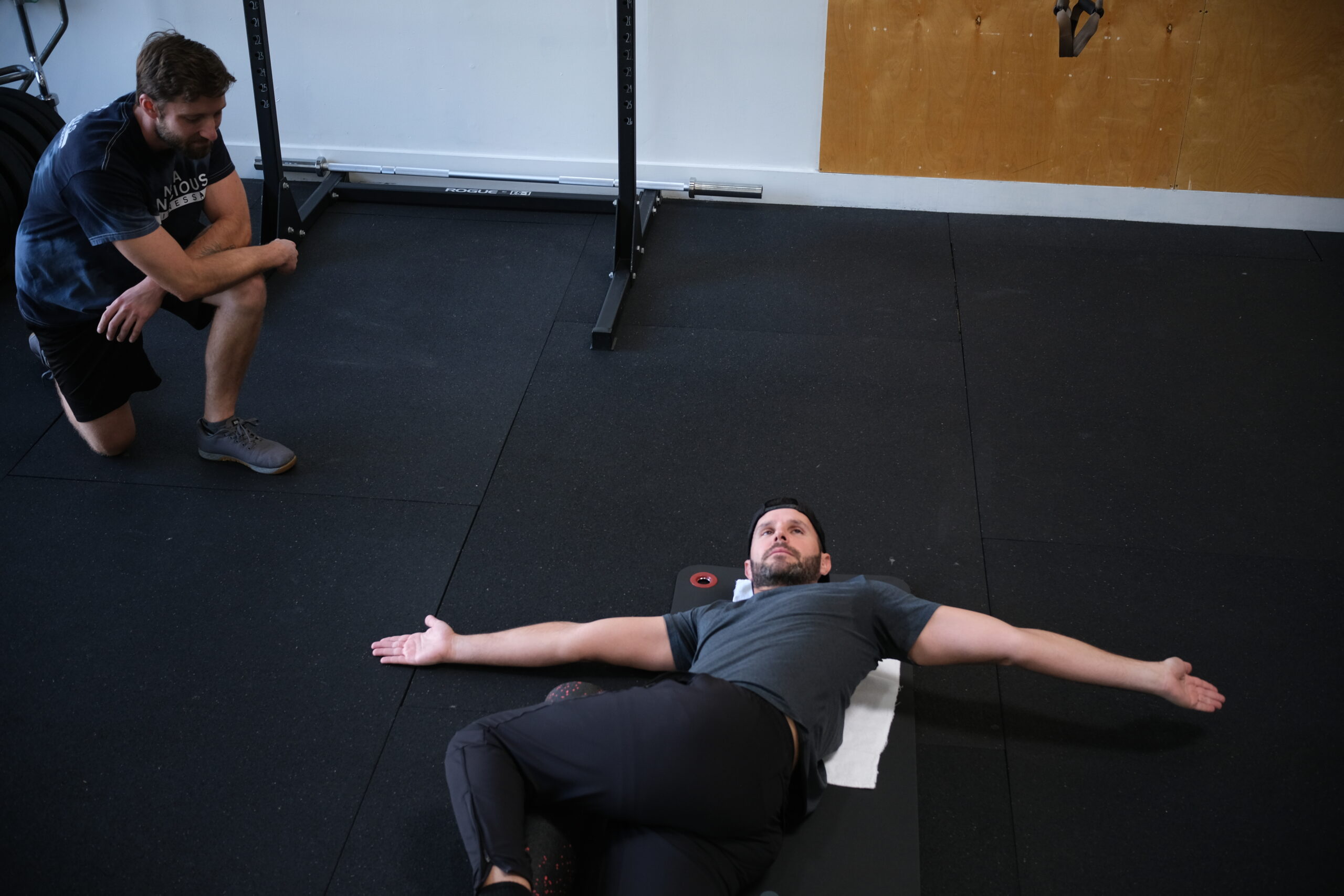
The side-lying open-the-book stretch is an exercise we use with our personal training clients to improve rotation through the neck and upper back. Resting the top thigh on a foam roller keeps the hips and lower back still, so the turning comes from the spine above the waist.
To perform the side-lying open-the-book stretch, lie on your side with a pillow under your head. Bend your top hip and knee to about ninety degrees and rest your top thigh on a foam roller in front of you. Extend both arms straight out in front of your chest, palms together. Keep your top knee pressed into the foam roller, then slowly lift your top arm and open it toward the ceiling and over to the other side of your body, like opening the cover of a book. Let your head and eyes follow your hand. Rotate only as far as you can while your knee stays on the foam roller, then exhale and return to the starting position. You should feel a stretching sensation across the chest and along the upper and middle back. Repeat this movement for five to ten repetitions on both sides of the body.
Practicing this stretch one to three times per week can help free up range of motion in the neck and upper back. This stretch also prepares the small muscles along the spine for quick turns and awkward reaches, which can reduce the likelihood of over-rotating or straining a muscle when the body isn’t ready. If rotational movements concern you because of a previous spinal injury, consider consulting a physical therapist or doctor before doing any thoracic rotation-type exercises.
A mobile, strong, and conditioned neck and upper back are an important part of our lifetime fitness journeys. Healthy rotation can help us back out of the driveway, finish a golf swing, and chase down a tennis ball hit wide of the court. Most importantly, it can help us walk into our next training session ready to follow the plan instead of having to modify it.
Sean McCawley, the founder and owner of Napa Tenacious Fitness in Napa, CA, welcomes questions and comments. Reach him at 707-287-2727, napatenacious@gmail.com, or visit the website napatenaciousfitness.com.