
At the end of September, I had the privilege of visiting a few friends in Portland, Oregon, for about three days. The weather was the quintessential Pacific Northwest climate. It was a little colder, the air a little wetter, and some drizzle had already started in the latter half of the month. This was a nice change from Napa, where we’ve had warmer weather and no rain.
Portland was beautiful. Brisk early mornings, epic sunrises, plenty of coffee shops, birds chirping around the city, and the occasional steampunk-graffiti-style mural on the side of a random building all made up the landscape. One of my favorite hobbies is visiting different areas and checking out their food scenes, and Portland didn’t disappoint. We were fortunate enough to enjoy a Malaysian-style dinner, a Vietnamese-style breakfast, and, of course, plenty of delicious donuts strewn across Alberta Street, Burnside Street, and Hawthorne Street.
We stayed in a very nice hotel right in the heart of downtown Portland. However, when staying at a hotel and sleeping somewhere other than your normal bed, a stiffer mattress can affect the joints in different areas of the body. This can be especially noticeable after a day of perusing a new city.
After waking up the first morning, I definitely felt the effects of a harder mattress and pillows that weren’t the ones I usually have at home. My neck, back, and shoulders were sore, and I felt like I had just tripped down a hill and collided with a tree. To help reduce the effects of sleeping in an unfamiliar bed, I made sure to practice some mobility techniques for my lower back and hips and some static stretching for my hips, knees, and ankles.
Another thing that helped keep my body in line was finding little opportunities to stretch throughout the day. One of those opportunities came about while riding the hotel elevator. I could’ve taken the stairs, but the elevator was already on its way down, and other guests were likely waiting for it too. We were going up five floors in what seemed like an elevator that was trying to break the Guinness Book of World Records for slowest elevator in the world. As the number changed on the display, a generic ding came from a two-inch speaker each time we passed a floor at about the speed of a snail crossing a hiking trail. I noticed this ride would take a while, so I decided to do a stretch we instruct our personal training clients to do when their ability to reach their arms overhead is compromised by a previous shoulder injury or deconditioned upper-extremity strength. We call this the shoulder glide stretch.
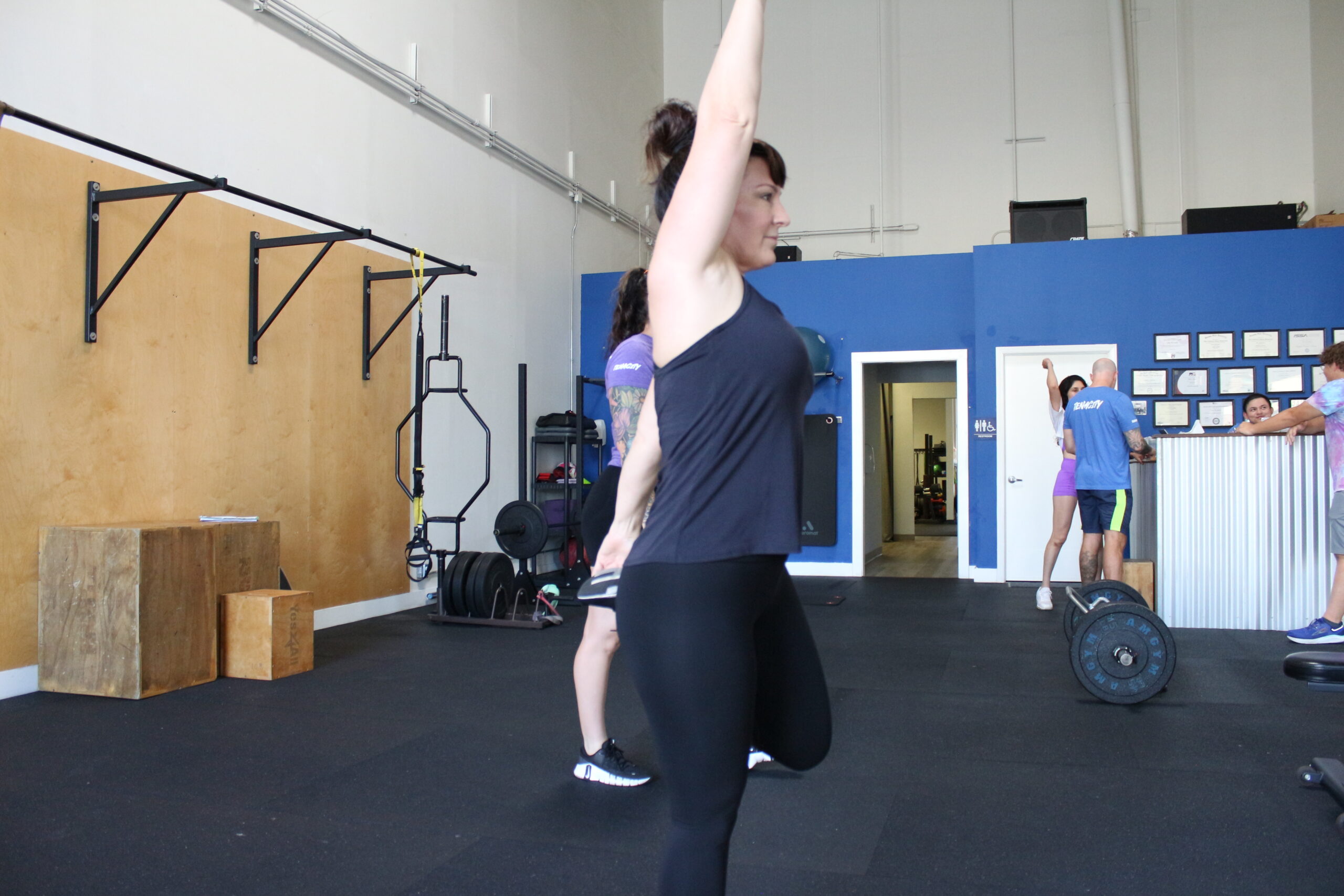
The shoulder glide stretch is an exercise we use with our personal training clients who might have tightness in the upper neck, the front of the shoulder, and the shoulder-blade area. Facing the wall in a split stance and reaching one arm up the wall stretches the hip flexor, abdominals, and shoulder region at once. It’s a safe, simple, and effective stretch for just about anywhere there’s a flat wall.
To perform the shoulder glide stretch, start in a split-stance position facing a wall, with one foot staggered forward and the other staggered back. Keep the knee and toe of your front foot close to the wall in front of you, and lift the heel of your back foot off the ground. While leaning forward and keeping your spine neutral and rigid, glide one arm up the wall, keeping your bicep next to your ear. Bring your chest and the back of your arm toward the wall until you feel a brief stretch in your chest, bicep, and abdomen. Hold this stretch for about five seconds, and then slide your arm back down. Repeat this for about five to ten repetitions on each side (or the length of one elevator ride to the fifth floor).
I could have just watched the digital display and listened to the chime letting me know I was getting closer to the fifth floor. However, I wanted to make good use of my time and help my body feel better after a night in an unfamiliar bed. By the time the doors opened, my shoulders and neck felt better, and my body felt a little closer to its normal alignment.
The human body adapts to the demands we impose upon it. Little, steady doses of movement, like a stretch in a slow elevator, can make a difference while traveling and in our everyday lives. Many of our clients find similar relief when they fit a few stretches into the moments between work, errands, and family obligations. Consistently practicing these small habits can help us keep feeling good enough to enjoy new cities, new food, and the activities we love for years to come.
Sean McCawley, the founder and owner of Napa Tenacious Fitness in Napa, CA, welcomes questions and comments. Reach him at 707-287-2727, napatenacious@gmail.com, or visit the website napatenaciousfitness.com.