Tag: diabetes napa

Functional Movement Training

What if getting stronger and preventing injuries wasn’t about doing more exercises, but about moving better? That’s the idea behind functional movement training. Functional movement training grew out of physical therapy, rehabilitation science, and strength and conditioning. Instead of isolating single muscles, it focuses on training fundamental movement patterns your body uses every day (e.g. …

Continue reading

Dynamic Stretching vs. Static Stretching

There are two primary forms of stretching we use with our personal training clients: dynamic and static. Dynamic stretching is performed before exercise.  Dynamic stretching can be defined as the act of moving through full ranges of motion to create short, repeated stretches that prepare the body for exercise.  A few examples include arm circles, …

Continue reading

Weight Loss and Optimal Eating Decisions

We’re entering the fourth month of the year, and New Year’s resolutions are in full effect.  Learning new skills, progressing toward new professional goals, and refining one’s overall sense of psychological and emotional well-being are among the areas people most often seek to improve in New Year’s resolutions.  Let’s not forget one of the top …

Continue reading

Posture Awareness During Squatting Exercises

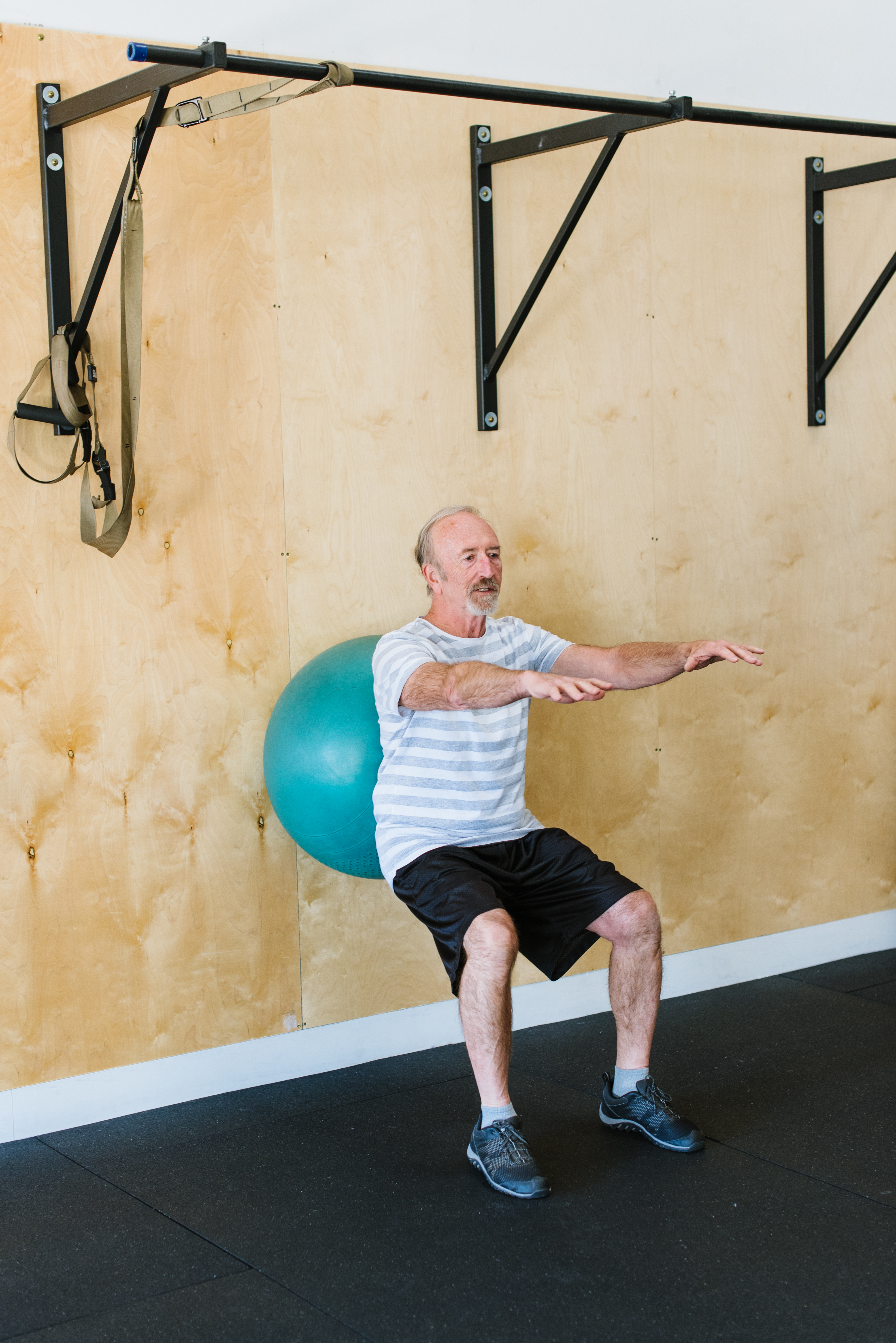
“Make sure you look forward,” I cued Tina, one of our personal training clients, as she was performing a set of “zombie squats” during one of her training sessions.  Her eyes darted toward me momentarily to receive the instruction and then returned to looking straight ahead.  She immediately rotated her head upward, with her chin …

Continue reading

Exercise Tip of the Month: Incline Eccentric Push-Ups

Push-ups are one of the foundational bodyweight exercises we incorporate in nearly every training program in our personal training clients’ exercise prescriptions. One variation we would like to highlight this week is the incline eccentric push-up. To execute this movement properly, place your hands on an inclined surface and “screw” your hands into the surface …

Continue reading

Exercise is Medicine for Knee Arthritis

Arthritis is a degenerative joint condition in which the smooth cartilage that normally cushions the ends of the joints gradually wears down. Healthy cartilage allows joints to glide smoothly and distribute forces during everyday movements.  Previous joint injuries, the repercussions of a life of manual labor in one’s career and lifestyle, or advancing age contribute …

Continue reading

Investing in Fitness and Daily Actions

Consistency can be defined as “the way in which a substance holds together” or “conformity in the application of something, typically that which is necessary for the sake of logic, accuracy, or fairness.”  Adhering to specific actions that reinforce health and well-being supports goals for a fulfilling and enjoyable livelihood.  Daily actions such as setting …

Continue reading

Variety in Movement Helps the Body Age Better

“I’m trying not to get old,” Nero responded after I asked how he was doing at the beginning of his training session. Nero is one of our veteran personal training clients with an animated sense of humor who uses physical activity as a key tool to empower his life. As a gentleman in his early …

Continue reading

Safe and Effective Exercises on the Ground

Exercise journeys can be challenging, depending on a person’s circumstances and physical condition.  The demands of time spent at our jobs, household chores, and family obligations can make it difficult to find time for exercise.  Previous or current injuries and health conditions can create a daunting experience when starting or re-entering a fitness routine, as …

Continue reading

Resistance Training is Medicine for Osteoporosis

The skeletal framework of bones beneath skeletal muscle is an important component for everyday functionality.  The brain acts as the central command center, sending signals down the spinal cord to the extremities, instructing them to move in a specific manner.  Muscular strength and neuromuscular coordination are essential for this process to occur efficiently and safely. …

Continue reading