Daily Hydration Tactics

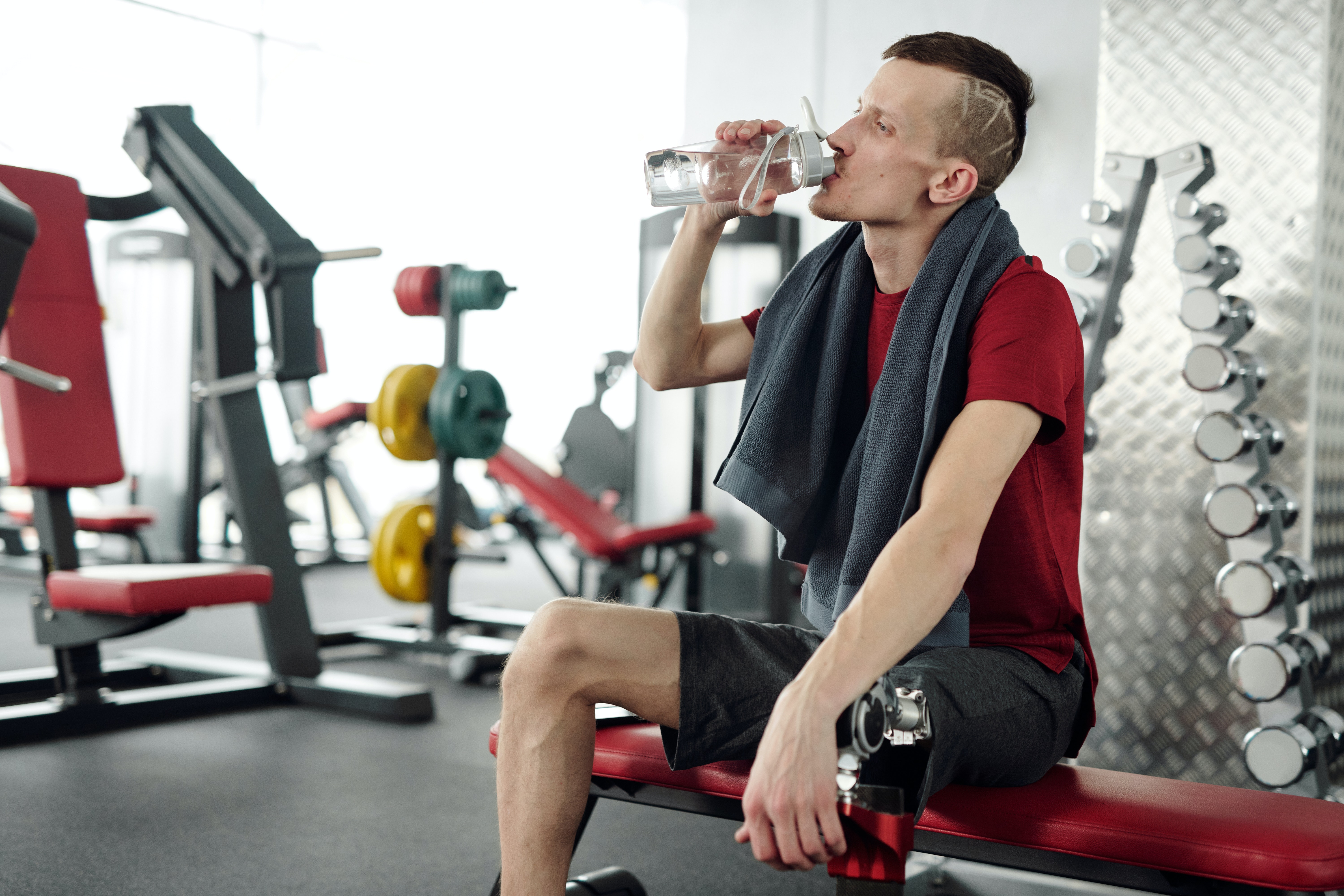
“How much water should I be drinking?” After completing a seventy-five-minute training session, one of our personal training clients, Ken, asked. “How much do you normally drink each day?” I replied.  “Oh, about two of these.” Ken said after holding up a twenty-ounce portable water container.

Before delving in further to a conversation covering advanced lessons on human physiological water requirements, I wanted to know what tactics throughout the day Ken was conducting for drinking water.  It was immediately apparent Ken wasn’t staying as hydrated as he needed to.  Educating him about minimal guidelines on water consumption would be the low-hanging fruit Ken required to reap the benefits of optimal hydration.  Therefore, it was time to put on my exercise physiologist detective badge.

I asked Ken if he drank any water first thing in the morning after waking up.  A brief “no” was the answer.  My second question was if he can recall what times throughout the day he drank water.  His response was “randomly.”  Third, I asked what other types of liquid he consumed normally in a day.  “Coffee, water, and wine” he replied.  Finally, I asked what his top three favorite foods were, he answered: “Oatmeal in the morning, salad and salmon for lunch, and steak and salad for dinner.”

These interview questions shed light on critical moments revealing opportunities to add more water throughout the day.  The first moment after waking is usually the most dehydrated period we are throughout the day.   We typically don’t consume to much water, after a six-to-eight-hour slumber.  If we drink water “here or there,” these random hydration periods are going to elicit a random hydration status.  The good thing is that Ken was consuming foods with high water levels.  Salad, salmon, and coffee have a high amount of water, contributing to overall daily hydration.  I asked these questions because these scenarios can be efficient reminder cues to consume water paired with everyday events.

Most of the time, we wake up and eat throughout the day.  So, why not pair a full glass of water with these moments?  It’s challenging to meet the recommendations for daily water requirements.  For instance, some guidelines suggest consuming your body weight in ounces.  Whereas other recommendations say ninety-six ounces, or one liter, is an optimal standard to adhere to.   Counting, tracking, and inputting data to ensure we meet our water requirements can get lost in the shuffle with all of the stimuli we endure throughout our everyday lives.  Sometimes, a viable tactic to support consuming more water is avoiding tracking things.  In fact, focus on pairing a glass of water with a particular recurring moment each day.

We recommend a simple and effective strategy to our personal training clients to consume a full glass of water first thing in the morning and after each meal.  This means right after you open your eyes in the morning, grab a bottle of water, a glass of water, or your fancy water tracking bottle and drink it.  Additionally, after you eat breakfast, drink a glass of water.  After you finish your lunch, drink a full glass of water. Finally, immediately following dinner, drink a glass of water.  Before you know it, you’ll be consuming four to five extra glasses of water measuring about twelve ounces each.  This could equate to an extra sixty ounces of water every day.

Hydration is critically important to many facets of our overall health, longevity as humans, and functionality in our everyday lives.  On average, many of us operate in a dehydrated state.  Calculating how dehydrated we are can be a burden to our lives, though.  Instead, focusing on improving our hydration status by regularly consuming water throughout the day is a far more attainable tactic to achieve than meticulously tracking things.  Let’s face it, tracking metrics can be mind-numbing. Instead, use the method of drinking water first thing in the morning and immediately after each meal as a way to invigorate our days without thinking about meeting a specific requirement.  You’ll feel lively, replenished, and ready to perform optimally in your daily life.

Sean McCawley, the founder and owner of Napa Tenacious Fitness in Napa, CA, welcomes questions and comments. Reach him at 707-287-2727, napatenacious@gmail.com or visit the website napatenaciousfitness.com.

Fear of the Gyms

As the weather gets warmer, daylight fills the sky longer, and the first quarter of the year concludes, people begin to settle into new habits.  New jobs, a fest set of classes at school, and new hobbies start to be ingrained in people’s lives.  Along with new year habits, exercises are usually a new tactic society wants to engage in as a regular part of their lives. So, what better way to leave the dark, cold and damp months behind us than by giving our bodies the gift of exercise?

As new inquiries reach out for guidance on exercises and personal training, we discover how raw some people’s relationship with exercise is.  A critically important initial interview question we ask our new exercise participants is, “What does your current exercise routine consist of?”  We get the former athletic and fitness veterans who say, “About two to three times per week. I do a few days at a local gym, maybe some Peleton at home, and I might do a Yoga class.”  When I hear this, I clap my hands.  Good for them.  Conversely, the other side of the new clients we interact with inform us that their weekly exercise status is “Close to zilch.”  This might be alarming, but the number of people who don’t participate in weekly exercise is surprisingly prevalent.

To guide individuals eager to improve health and fitness in a positive direction, we discover what obstacles impede them from achieving their fitness goals.  The popular response is time, work, kids.  Family and financial logistics should prioritize our lives to function as humans in our present society, optimally.  However, some people are just straight-up scared of exercise.  We hear statements from our community that make exercise sound just as terrifying as spilling your coffee on your Armani white button shirt before a job interview.

Entering the sliding glass door of a new gym for someone utterly foreign to this environment can seem like a stepping foot into Jurassic Park.  Gyms impose an intimidating presence.  Taking a tour through the weight room floor after 5 PM could be horrifying for some.   You might find a “bro’d out” group of high school and college age young gentlemen wearing shirts without any sleeves and ear buds in listening to the latest jam.  The visual display of grunting like a wild gorilla while sweating profusely as they press a heavy weight over their head isn’t a rare sighting.  Travelling over to the group fitness class sector, you might come across a few ladies dressed in Lulu Lemon gym attire with the image that they may be entering a gymnastics competition.  One might think those outer brackets of the gym might be a little too advanced. Perhaps the center of the gym could be a little more welcoming.  But, think again, a trip to the center of the gym has rows of steel devices with cables, stacks of cast iron weights, and a seat known as the weight machines. For the rookie gym-goer, one might think they are making a trip to the dentist while sitting in a Transformer.  Jurassic Park, wild gorillas, gymnastic competitions, and large metal contraptions?  I’d be a little scared too if I stepped foot into that world.

What can we do to lower this curtain of gym anxiety?  This is an important question to ask novices in the exercise arena who have anxiety similar to the army of Spartans going into a sea of arrows that blacked out the sun in the movie 300.  One of the first steps is to understand that exercise does not need to be a rigorous event in the gym.  Granted, I have been a gym rat the majority of my life since my dad purchased me a membership to a gym when I was eleven years old.  I felt the gym was my safe place.  However, I can put myself in another’s shoes who view the gym as a jungle.

Performing a full-body resistance training routine using only three pieces of equipment will offer the life-changing responses necessary to a human’s life without having to step foot in the gym.  The trick is knowing what the basic and straightforward mechanisms of exercise can do.  These three items include the ground beneath your feet, gravity, and your body.  Fortunately, if you’re reading this article, you already have those items in your possession.

Exercises such as prolonged walking, hiking, or walking up and down sets of stairs offer your body cardiovascular and strength improving adaptations.  If you want to challenge yourself with a workout, find out what distance you walk, how many times per week, and how many sets of stairs you travel up and down each week. Then, multiply these factors by two.  If you’re only walking one block per day, walk two.  Or if you don’t walk at all, start walking one block.  If you hike once per week, hike twice.  If you don’t hike at all, take a trip to a local park with a slight incline and walk five to ten minutes.

The beauty of the body’s physiology is that it will adapt to the physical demands we expose it to. So, if you’re starting from ground zero, take a look around and see what you have to utilize for exercise.  If it’s a Peleton, a membership to the gym, or a ten pack of Yoga classes, adhere to using those resources at least once each week.  However, if you’re a little greener around the edges, know that you’re not alone.  Just know that your desire to improve your fitness can start right in front of you.

Sean McCawley, the founder and owner of Napa Tenacious Fitness in Napa, CA, welcomes questions and comments. Reach him at 707-287-2727, napatenacious@gmail.com or visit the website napatenaciousfitness.com.

Strength Training for Bone Health

The human body is comprised of a collection of skin, blood, muscles, nerves, and organs vital to our sophisticated interaction in our environment.  The supporting infrastructure holding these organs together are the complex collection of bones making up our skeleton. Bones are considered connective tissue along with our skin, muscles, ligament, tendons, and fat.

Connective tissue possesses collagen as a primary component to adhere cells to each other. This gives cells a rigid yet pliable property depending on their specific action.  Skin is the most pliable. Acting as a wrapping, it coats muscles and encases blood.  Muscles are elastic and are the primary motors offering movement to joints in various ranges of motion.  Tendons attach muscles to bones.  Ligaments are the nuts and bolts pinning our joints together.   These unique connective tissues are intertwined with collagen giving them the architecture necessary to have structurally supportive properties.  Cells without collagen portray more liquid, viscous, or gelatinous properties, such as blood and fat cells.  In contrast to the rest of the body’s cells, bones have the most tightly packed amount of collagen present in their cells.

This is valuable information for individuals afflicted by forms of arthritis, bone density deficiencies, or nagging aches and pains in joints.  Appreciating the adaptive properties bones acquire from exercise can help our society decrease the severity of arthritis, increase bone strength, and avoid devastating bone injuries.

We’re all familiar with the way scrapes and cuts on our skin heal.  After a few days, minor scrapes and scratches start to develop scabs that slough off, leaving a new path of skin where the scab once resided.  A commonly understood principle of muscular development, via exercise, is that stress applied to muscle causes microtears to the skeletal muscles.  Performing the same sequence as the way the skin develops scars, muscles cells use satellite cells and collagen within our system to lay over the top of microtears within the damaged sites of the muscles.  This repair process makes the muscle more dense and able to manage more stress.  Our bone cells are called osteocytes, which are connective tissue akin to their cousins, the muscle cells.  Therefore, bones recover similarly to an imposed stress demand similar to their cousins.

As muscles endure stress from exercise, the muscle pulls on the attached bone.  This pulling action causes stress to the osteocytes within the bones.  As the bones endures this stress, a message is relayed throughout the body to attract satellite cells and collagen to the point of stress.  The bone cells gladly accept this message and take in extra oxygenated blood, satellite cells, and collagen to the site of a bone, requiring more reinforcement.  Therefore, stress imposed by exercise triggers the synthesis of density within and around bones connected to muscles enduring rigorous physical activity.

Exercise adherence is critical to mitigating degenerative bone disease and the effects of catastrophic injuries caused by brittle bones.  The last thing someone wants, when having an advanced case of arthritis or low bone mineral density, is to fall and break a bone.  By reinforcing the integrity of our bone cells, the likelihood of fracturing bones during an unforeseen injury can be decreased.  Therefore, complying with an exercise program consisting of one to three days per week of strategically designed resistance training targeting the neck, shoulder, spine, hip, knee, and ankle joints can significantly increase the body’s ability to build strength in our bones.


Sean McCawley, the founder and owner of Napa Tenacious Fitness in Napa, CA, welcomes questions and comments. Reach him at 707-287-2727, napatenacious@gmail.com or visit the website napatenaciousfitness.com.

Exercise the muscles you don’t use

The human body is made to adapt to the stresses imposed on it.  Climate, physical labor, and tasks requiring mental capacity are a few examples of the jobs we endure throughout our everyday lives.  Two prime examples of categories of professions include construction workers and desk jockeys.

For example: construction workers lift heavy boards over their heads, hoist bags of concrete on their shoulders, or hold a gyrating jackhammer as it pulverizes asphalt.  As a result, the upper body musculature of construction workers is built strong, the circumference of their arms is akin to Popeye’s anchor-tattooed forearms, and their hands and fingers can catch bricks thrown from twenty feet away.

On the opposite side of the spectrum, the eight-hour desk workers can sit down in one spot performing administrative tasks on their computers and phone.  Their mental bandwidth can cut out all distractions as they support the other sophisticated aspect of our society. The ability to communicate, calculate, and decipher solutions to customer services, software, and administrative careers is an essential pillar to humanity, which requires individuals to focus on analyzing, archiving, and completing administrative tasks.

These trades require a tremendous amount of skill.  Not everyone can commute a few hours to a job under the hot sun or in the chilly morning demanding a human to endure the elements and fasten eight-foot-long boards to each other for hours on in. Additionally, completing intense physical labor in extreme heat or cold climates is impressive.  Personally, I’d have to take a few more breaks than my friends wearing hard hats and orange vests.

Furthermore, a person who can look at a stack of papers on their desk, sit down, and address the logistics required to decrease the height of the documents take a tremendous amount of focus and patience.  Wash that down with looking at a computer screen and performing duties on our phones. These desk working professionals have a serious set of skills in which an immense amount of tasks can get accomplished by sitting in one place for a prolonged period of time.

The skills of construction and desk working trades are a specialty acquired over years of experience.  Even though both of these trades reflect a masterpiece of how humans can perform, an aspect can hinder this remarkable display of human performance if left unattended.  These two styles of workers can develop physical and mental symptoms of overuse or underuse.

The construction worker might have enough strength to wrestle a wild bear after they endure ten plus years of manipulating boards, cement, and steel beams.  However, what happens when the lower back takes on too much load?  Or, the muscles responsible for holding boards overhead in the shoulder rotator cuff become overworked?  For the construction worker, it might be worthwhile to focus on the muscles that aren’t necessarily used throughout their days if they focus on the longevity of their career.  Perhaps exercises such as planks to strengthen the muscles around the spine, shoulder injury prevention exercises to strengthen the rotator cuff of the shoulder, or mobility exercises to support flexibility and mobility of various positions their bodies endure would benefit them the most.  If a construction worker is already lifting heavy objects for eight hours, do they need to hit the weights at the gym?  Maybe focusing on movements that aren’t utilized during their workdays could balance their overall fitness.

The desk worker can suffer from underuse injuries.  There are times when an astronomical number of tasks can be accomplished in one day when focusing on administrative tasks on a computer.  However, when humans park themselves in an ergonomically-sound chair, their body stops moving.  This means that muscles don’t activate throughout any labor except the wrist and finger flexors and extensor responsible for typing over one hundred words per minute.  The muscles of the neck, shoulder blades, back, abdominals, hips, and knees lay dormant in hours of hibernation.  The lack of physical activity promotes decreases in oxygenated blood flow to the muscle, the stiffening of the infrastructure of the muscle cells that hold together joints, and a reduction in the number of calories expended throughout the day.  For the desk worker, taking time away from what they do best and focusing on exercises that get them moving in everything but a seated position will be the key to a long and productive career.

We appreciate both the people who swing hammers and the ones sitting in a chair for eight hours.  Take some time to respect how skilled we are in our careers.  We all have unique skills that allow us to contribute our talents to society.  However, we want to be the best we can at the tasks we perform in our everyday lives.  Look at the movements we don’t participate in throughout our days.  We can improve the function of our bodies to supercharge the physical activities we perform in our careers by adding exercises into our fitness routine that targets areas of the body we don’t use in our days at work.

Sean McCawley, the founder and owner of Napa Tenacious Fitness in Napa, CA, welcomes questions and comments. Reach him at 707-287-2727, napatenacious@gmail.com or visit the website napatenaciousfitness.com.

Relationship with Exercise

A doctor’s appointment sometimes includes completing a questionnaire asking how many days we perform strenuous physical activities per week.  Our three-by-five-inch digital leashes, known as phones, have fitness ads on any entertaining platform installed to the device.  Celebrities, pro athletes, and our favorite social media icons flaunt their aesthetically pleasing physiques, making viewers think, “I want to look like them.”

A multitude of research supports the rationale that exercise helps us function as humans. Therefore, complying with an exercise program including themes of injury prevention, weight management, and strength training can help us move better, experience less pain, avoid becoming overweight, and fend off against a potpourri of disease.

These factors and many others serve as motivation to exercise.  None of the above examples are a terrible thing to use for inspiration to improve health and fitness.   Any stimuli to increase human activity is beneficial in today’s era because there is a high magnitude of sedentary professions.  We might observe a few workouts picked from a social media article, fitness blog, or a friend who is into working out.  These workouts might include running, participating in a Peleton biking class, joining a Yoga class, or performing resistance training at a local gym.  They’re all incredibly effective.  Sometimes, we do this during the first two weeks after initiating a program. Then, a few weeks later, we might stop.  Why is that?

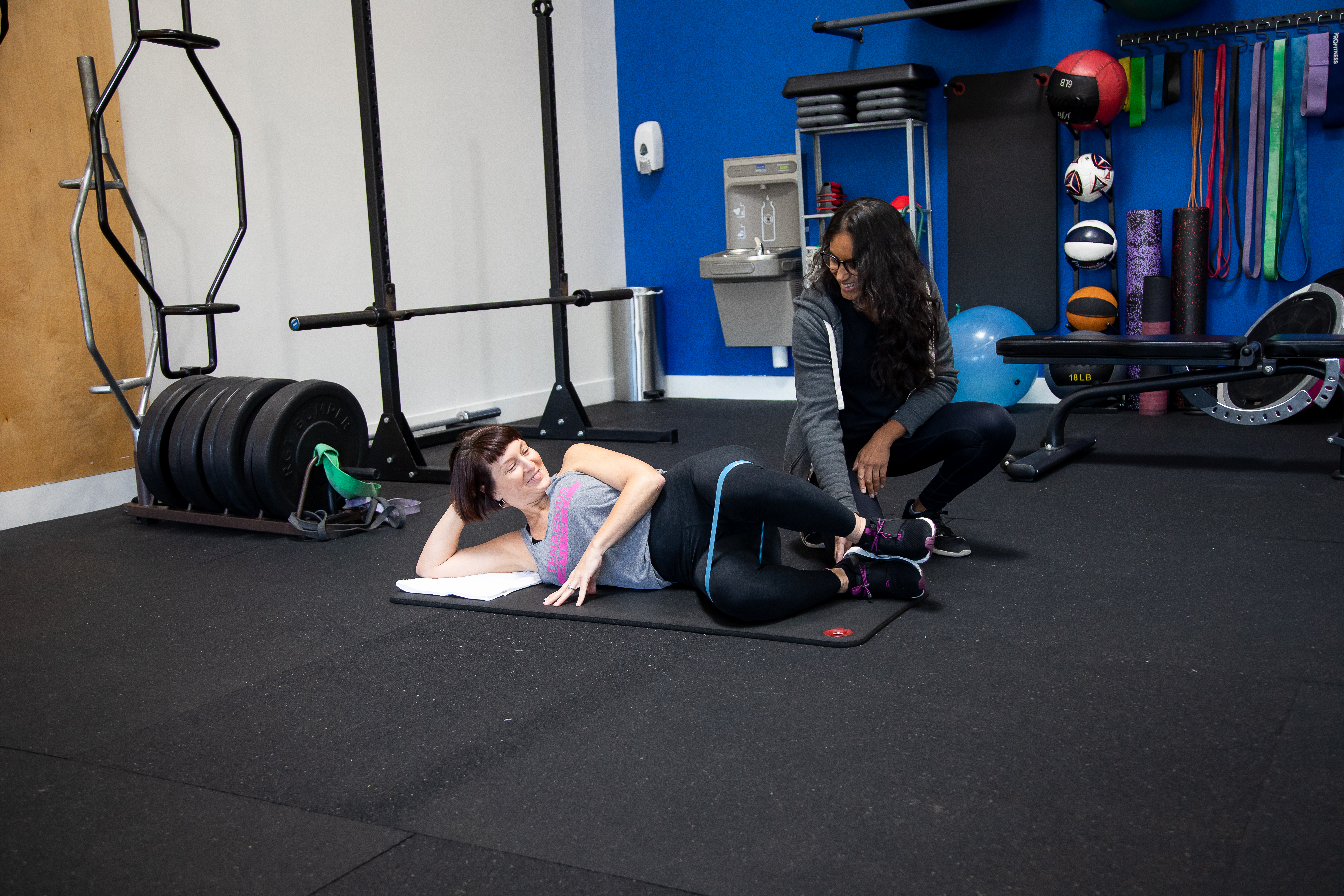
During the conclusion of one of our personal training sessions, I interviewed a client about her goals for her next four-week phase.  This is an excellent opportunity to ask goal discovery questions because people enjoy sharing what they want to achieve and work toward in their fitness journey immediately following a successful four-week exercise prescription.  However, this client expressed some struggles.

First, she shared, “I need to work on my relationship with exercise.” Then, as we discussed her efforts more she asked, “Should I run more, lift weights, or hike more?  I can’t come up with a reason to do these things.” She continued, “I know all of those activities are good, I’m just not motivated to do them.”

This isn’t an uncommon problem for society’s relationship with exercise.  There are times when people show up to an exercise class, a personal training session, or peruse around the weight room of a local gym.  For some, the perception of stepping foot into one of these fitness arenas complete the nagging task of filling in the fitness category in the doctor’s questionnaire.  However, there’s far more to staying healthy and active than just checking off a box that you’ve done what you were told in a doctor’s office.  An active lifestyle offers far more gifts than a simple check mark at the doctors office.

A helpful tactic that this client and I spoke about was finding out what gifts exercise brings her.  After asking her why she does the Peleton class, she answered, “I think it’s fun.  It’s interesting for me to see my rank increase in a class full other individuals my age.”

I continued to ask her why she thought running was helpful, “I think it tones my core like no other exercise.  Plus, I would like to be able to run if it was necessary.  For instance, if someone stole my pet lizard.  I’d want to run after them and be able to catch them” she energetically replied.

The third question I asked was why she liked to come in for her personal training sessions and perform weightlifting exercises.  “To be honest, lifting weights and doing these weird exercises you guys have me do is challenging.  I get the idea of why to do them, but I don’t necessarily understand the full benefit.  I guess that’s why you guys are here to teach what these exercises are doing for my body and to make sure I don’t hurt myself.  The main reason I keep coming back to the gym is that I always feel better after I leave.”  She continued, “Sometimes work is stressful.  I have to be on Zoom calls for hours, take notes, and have challenging conversations.  By the end of the day, I’m fried.  So coming to my personal training session, putting my phone on silent, and getting coached shuts that stress off.”  She concluded with, “And, that feels good.”

“Fun,” “like no other exercise,” “feels good,” and “I feel better when I finish.”  These are all descriptions of how devoting time to exercise can be beneficial.  It doesn’t take much effort to focus on stress, hardships, and look for what’s missing in our lives.  We have to work hard every week which isn’t easy. However, if we can pick out the feelings at which exercise gives us little presents to enhance our lives, perhaps we can understand the reasons behind putting ourselves through a physically challenging experience.  If you have struggles adhering to an exercise program, pick out a few keywords of how exercise will make you feel like what you’re doing has value.  Sometimes the answers to simple questions starting with “why” can clarify our struggles while opening a path to success in our lifetime fitness journeys.
Sean McCawley, the founder and owner of Napa Tenacious Fitness in Napa, CA, welcomes questions and comments. Reach him at 707-287-2727, napatenacious@gmail.com or visit the website napatenaciousfitness.com.

Reasons To Do Push Ups

Possessing a developed upper shoulder, chest, and triceps region means more than having the ability to sport a tank top on a seventy-eight-degree, sun-filled day in northern California.  The musculature of the upper extremities has many valuable functions.  In particular, the muscles responsible for arm extension are at the top of the list of essential body parts for upper body strengthening exercises.  Much like Alaskan King Crab is in the upper echelon of the seafood world, the pushup movement sits on the throne of upper body exercises.

Muscles involved in performing an optimal pushup include the upper deltoid, pectorals, core stabilizing muscles around the anterior and posterior trunk, and the magnificent triceps, located on the posterior (rear) side of the arm.  We spotlight triceps in our personal training clients’ exercise prescriptions because of its application to important facets of our everyday lives.  Triceps are involved in various applications in our lives whenever we extend our arms in front of us or when pushing off against something.

Leaning against a wall to bend over and slide on loafers requires arm strength to hold oneself up while posting an extended arm against the wall.  Getting up from the seat of your car during a routine trip to the supermarket involves using the arms to push ourselves out of the seat.  A ritual all humans participate sometime throughout the day are visits to the bathroom, in which we push ourselves up from the toilet by posting our arms on our knees to stand up.  Performing these tasks without sufficient triceps strength could put us in a situation in which we avoid certain activities due to a lack of strength.

Specific populations view getting up from the ground as a daunting task.  Individuals with knee injuries, just getting out of surgery, overweight, or someone of advanced age can have an extra challenge dealt to them when presented with getting up from the floor.  These physical afflictions have correlations with decreased triceps strength.  If we shed light upon these activities, we can appreciate the importance of upper extremity muscle strength responsible for pushing the body away from objects.

An exercise technique we focus on with our personal training clients is the mastery of pushups.  This exercise applies muscular stress to a vast surface area of upper extremity muscles.  No matter the fitness levels, some form of push can be used to improve upper body strength for extending the upper arm’s ability to push the object away from the body with the arm.

Here are a few exercises we start with as a foundation with our personal training clients to build base level strength of the muscles of arm extension:

  1. Incline straight arm plank: The plank exercise is one of the most straightforward exercises to master and helps to obtain optimal upper body strength.  Aiming to hold a plank for thirty seconds while posting the body over the ground with a rigid spine indicates that the arms supporting the weight of the body for a prolonged period has optimal strength.  If you are unfamiliar with how to perform the plank, start by practicing the planking exercise on a stable, inclined surface. For example, a countertop.  While maintaining the spine in a rigid position and ensuring the body is straight, post the arms on the countertop and hold this position for fifteen to thirty seconds.  Over time, the body will become stronger.  As the body gets stronger, hold the position for a more extended period.
  2. Half Depth Incline Pushups: Mastering the ability to efficiently move your body up and down while in a face-down position requires optimal upper-body pushing strength.  As much as being able to push oneself up from a prone position is where we want our muscles of upper body pushing movements to be, understanding how to layer strength and build muscle is essential.   If performing a pushup from flat on the ground is a challenge, revert to the example of modifying the plank exercise and position yourself on an inclined surface.  Additionally, shave off another layer of difficulty by performing a pushup with only half the distance traveled toward the ground.

The thought of performing pushups can be intimidating.  Visions of Sylvester Stallone sweating profusely as his eyes are in a crazed red glare while doing four thousand pushups to train for his bout against Ivan Drago can flash through people’s minds at the very thought of pushups.  In other words, this movement can be intimidating. Of course, this exercise doesn’t need to be an example of a bout of Olympic-level human performance.  The pushup is an exercise that deserves more attention due to it’s convenience to perform, and it’s a direct application to its ability to help us operate efficiently and without pain in our everyday lives.


Sean McCawley, the founder and owner of Napa Tenacious Fitness in Napa, CA, welcomes questions and comments. Reach him at 707-287-2727, napatenacious@gmail.com or visit the website napatenaciousfitness.com.

Consistent Healthy Decisions for Weight Loss

One of our personal training clients was preparing for a ten-day vacation to the beaches of the Algarve in Portugal.  As the aquamarine water surrounding cities threaded with historical roots awaited her arrival, she mentioned she wanted her body to feel and look spectacular for this monumental adventure.  Shedding ten pounds and trimming up her figure was a top priority as she envisioned herself enjoying one of the most sought-after beaches in the world.

I asked what goals she wanted to achieve in the three months before she disembarked. She replied, “I want to trim some of this extra cushioning from around my muffin top, armpits, and the back of my arms.”  Three months seemed like plenty of time to accomplish such a goal.  Research supports that weight loss and converting fat to lean muscle mass are most effective following a ninety-day game plan of exercise adherence and compliance to a refined diet.

“What can I do to make sure I achieve these goals?” She asked.  To lay the plans of achieving the leaner body she desired, I needed to collect data on her current exercise regimen and dietary practices.

I asked, “What are you currently doing to support your efforts of ‘trimming up’?”  She replied, “I had a salad yesterday for lunch.  It had lettuce, spinach, arugula, white beans, green beans, and some grilled chicken on top of it.”

Admiring her description of choosing a healthy dish for lunch, I gathered some more information. “That’s a fantastic start. What did you have for lunch the rest of the week?”  It appeared this question caught her off guard. “Well, I’m struggling to recall.”  After a moment of recalling her lunch time meals throughout the previous week, she said, “Monday I had a deli sandwich.  Tuesday, I went to Taco Bell and had a taco salad because it was close to where I work.  On Wednesday, I had a veggie wrap from a local restaurant.  Not too bad, right?”

I wanted to congratulate her for including vegetables during each lunch meal.  However, the collection of eating out at restaurants every day and the consumption of processed carbohydrates in each meal weren’t exactly in line with her goals of shedding unwanted fat and gaining lean muscle mass.  Additionally, the struggle to recall what foods she chose for her lunches showed up as a red flag as well.  If it is challenging to identify what meals were consumed in a weeks time, there’s no telling what other food options might hinder her success.

Choosing meals throughout the week that have vegetables included is a great start.  However, it’s noteworthy to notice all of the items attached to each meal.  The deli sandwich contains two thick pieces of bread consisting of additional calories and insulin spiking flour.  A taco salad from Taco Bell has a large fried tortilla bowl comprised of processed carbohydrates.  The veggie wrap is encased by a flour tortilla adding extra calories and further compounds the influx of insulin into the bloodstream.  We could identify an obstacle that needed some tuning up right off the bat during the lunch hour.

I could perform a complete analysis of every meal she consumed for breakfast, dinner, snack times, and dessert as well.  Perhaps analyzing how much alcohol she consumed throughout the week would lay the groundwork for improving and supporting her weight loss efforts.  However, I didn’t even want to venture past what she had outside of lunch.  If her lunchtime meals were what she thought was fueling her success, my knee-jerk reaction as her coach was to feed off what she was doing well.  To ensure she sustained her optimal performance of her lunchtime meals, I informed her of some suboptimal choices she was displaying.

After a brief pow-wow on the detrimental effects of consuming high glycemic index carbohydrates for a few days in a row, the lessons sunk in.  It was time to focus on one of the most critical concepts in any fitness journey: consistency.  We decided to focus on one tactic: limiting herself to eating out at restaurants to only twice per week.  She would be assigned to create her lunches and bring them to work the rest of the days. In addition, she agreed to include only one handful of carbohydrates in each of her lunch meals.  For example, if she wanted to have rice, she would envision only a handful of rice on her plate.  This method would trigger less unnecessary carbohydrates stored as fat when left unutilized.  More importantly, this would be a critically important assignment for demonstrating that she will be in charge of what foods she is putting in her body if she consistently practices this tactic.

The fitness goal of obtaining a body with a high concentration of lean muscle mass is strongly desired and challenging. In addition, a strong and healthy body is an essential factor in feeling happy when on the vacation of a lifetime.  To maintain a lean and healthy body, identifying consistent healthy food decisions throughout the week is a simple and effective place to start.

Sean McCawley, the founder and owner of Napa Tenacious Fitness in Napa, CA, welcomes questions and comments. Reach him at 707-287-2727, napatenacious@gmail.com or visit the website napatenaciousfitness.com.
Back Pain Solutions

Napa’s Highway 29 serves as a central transportation system for local Napans to travel north and south throughout the valley.  Reasons for travel might include heading to work up valley in St. Helena or Calistoga, heading south into Napa from St. Helena to drop kids off at school, or for tourists utilizing travel agencies and wine tours to visit Napa Valley’s sought-after winery experiences.

The two branches of primary transportation consist of Highway 29 and Silverado Trail. Therefore, appreciating the infrastructure of Napa’s two main highways is essential to the optimal function of people living in Napa.

If we view these two long roads from an overhead view, you’ll see they resemble straight lines connecting the north to the south end of the valley.  A screenshot from a Google Earth image of Napa Valley’s map reveals the long roads starting from the south of the county spanning to the north.  Zooming in closer, satellite images of Highway 29 reveals crossroads connecting the western Highway 29 to the eastern Silverado trail.  Additionally, roads from Napa County’s major towns of Napa, Yountville, and St. Helena funnel into the pillar of more extensive and longer roads, allowing speeds of sixty-five miles per hour.  These long roads allowing fast travel with limited stop lights are designed for the most efficient transportation of humans going from one end of the county to the other.  Napa County’s Highway 29 and Silverado Trail are the core of sending humans from the farthest part of Napa County to the other.

We have a similar structure to highways located in our body that transports messages to and from various locations in our body.  It’s located in the center of the body and has networks of cells that allow for the transportation of electric currents responsible for powering our organs, nerves, and muscles.  This centralized highway within the human body is the spine.

The spine has a wide array of nervous system networks that power our heart, digestive system, and extremities, to name a few crucial factors. The different portions of the spine innervate unique parts of the body.  For example, parts of the cervical vertebrae have “roads” of nerves that branch from the spine and travel down the upper extremities.  The thoracic vertebrae located in the rib cage region has pathways of nerves responsible for the function of the lungs.  The lower portion of the spine, at the lumbar vertebrae, have large nerves that travel down the lower extremities to power the muscles of the legs. A well-known main freeway that has many sub roads branching from it is the sciatic nerve.

Once there is a highway lane closure, Cal Trans workers have a detour put up. Or, there is a vehicle needing service on the side of a highway, the rate of travel for the humans in their cars slows down.  The spine is identical when there is a blockage in the nerves that travel from the spinal cord to organs and extremities. For example, a compressed disc or an inflamed muscle surrounding the spine can cause a blockage in one of the nerves sending signals from the spine to the path of travel the electronic signal is meant to go.  Common instances might include a tight neck sending tingling sensations from the armpit down to the fingertips or a tight back compressing sciatic root nerves budding from the lumbar vertebrae producing pain down the back of the leg.  If blockages in the spine occur like blockages in freeways, the signals sent from our spine to our nerves can’t efficiently give messages to the body.

Fortunately, our body isn’t dictated by the wear and tear of the asphalt of a freeway or how fast our beloved Cal Trans workers can repave a road.  The person responsible for the efficient travel of the messages sent from our brain to our nervous system is the person we look at every morning in the mirror; ourselves. Therefore, spine injury prevention is essential for the efficient travel of electronic signals sent from our brain to our body.

Engaging in routine exercise one to three times per week significantly reinforces the structural support of our spine.  One of the most straightforward exercises to bolster the bracketing around our spine is the straight arm plank exercise.  By holding a plank for fifteen to thirty seconds, the skeletal muscle surrounding each vertebra receives oxygenated blood flow; influencing the maintenance of muscle cells to help the spine support itself through physical stress. Likewise, engaging in a Yoga or Pilates class influences rotational, up and down, and side to side movements of the muscles holding the spine together.  By engaging in physical activity that keeps the spinal muscles active, we perform proper maintenance on our main freeway of nerves, similar to how a highway stays paved after a team of Cal Trans workers resurfaces a road.

Understanding the significance of a healthy back is vital to the quality of our everyday lives.  Like the way a road needs maintenance, so do the roads responsible for our nervous system traveling within our spine.

Sean McCawley, the founder and owner of Napa Tenacious Fitness in Napa, CA, welcomes questions and comments. Reach him at 707-287-2727, napatenacious@gmail.com or visit the website napatenaciousfitness.com.

Staving Off Illness

Coming down with an illness is the last thing someone wants to be added to their life.  If we turn on the news, we get reminded of every last number and data point of how sick our world is.  A Pickleball colleague and I were practicing at the pristine Yountville Pickleball courts the other day.  The vineyard traced backdrop on the other side of the fence is enough to make anyone feel like they are on a blissful vacation.  During our practice session, my partner asked me if we had seen our usual January burst of personal training inquiries eager to achieve their New Year’s fitness resolutions yet.  I replied that our intake of the typical New Year’s surge of hungry exercise participants was less prominent than usual.  When my partner asked why these numbers weren’t our usual influx of inquiries, I noted that one barring factor was that people did not want to get sick.

My partner added, “One would think a small gym setting with an appointment-only based system and only four people  in the room would remedy the fear of coming down with something.”  I added, “Unfortunately, as we have a high intake of inquiries, some people wanted to put their participation on hold even though we offer an exclusive and private one-on-one setting.”

In an era where being free of sickness is one of the most highlighted themes in our everyday lives, prevention and avoiding presentations of disease is one of the most powerful actions we can focus on to ensure our health.  However, if we stay inside and lack the effort to initiate physical activity, the likelihood of sickness and many other suboptimal physical ailments get put on the table. Therefore, physical activity is one-hundred percent critical to living a healthy and disease-free life.

An adage my fourth-grade teacher told our class sticks with me.  “If you drink enough water, wear the right clothes, eat the right foods, and stay clean, you won’t get sick.”  By sticking to such simple guidelines set by a fourth-grade teacher, we have the potential to influence an active and disease-free life positively.

To put those fourth-grade lessons into action, here are a few guidelines that could help us stay away from sickness:

  1. Drink enough water: Our bodies depend on water for many functions.  Optimal blood pressure, the transport of vital nutrients, and fueling the function of immune cells in our body are just a few components adequate hydration contributes to.  Having a glass of water after each meal throughout the day is a simple and effective tactic to ensure our water concentration remains in an optimal state.
  2. Wear the right clothes: Is it cold in the morning?  Then bundle up:  wear a beanie, dress in layers, and make sure to stay dry.  Fluctuations in our body temperature can put stress on our body and cause our immune system to act erratically. Also, we don’t want to get a head cold or introduce any other symptoms that give us headaches, runny noses, or fevers.
  3. Eat the right foods: Has anyone ever woken up with a headache?  Perhaps from a few glasses of wine or one extra beer than you usually had last night?  Another common symptom is feeling cloudy-headed or having an upset stomach in the morning after having too much pizza, chocolate, or ice cream the night before.  If we can eliminate headaches, stomach aches, and the feeling of head fog in the morning, we won’t experience symptoms that make us feel like we’re coming down with the next cutting-edge virus.
  4. Stay clean: I’m sure we all know that going in and out of a gym can leave some amazing substances on our bodies clothing.  Sweat, dust, and whatever other gym funk our imagination can muster up is no surprise.  However, the substances present in a Yoga, Pilates, or a one-on-one personal training studio aren’t much different from the germs present at a restaurant, local bar, or grocery store.  No matter the setting, ensure to wash your hands, wash your clothes, and take showers to disinfect our bodies.  There may not be a perfect solution to avoid germs and viruses entirely.  However, by emphasizing the cleanliness of our bodies, we can mitigate how severely icky germs and filth might affect our health.

Our society is in the sense of awareness of avoiding illness for obvious reasons. Even a human living under a rock would know the severity of the Corona Virus crisis.  Data is at an all-time high of how a healthy diet, plenty of vitamin D, and a healthy and mobile body fend off the effects of illness.  These essential facets of human health offer significantly more benefits than pills, medicine, or vaccines.  We might need to roll the dice when we enter a local gym.  Who knows, you might come down with something.  However, a trip to the store, the gas station, or a restaurant isn’t much different in the exposure of what might get us sick.  Our willpower and perseverance to make a trek to a local gym, take a Yoga class, or participate in outdoor physical activity are equally, if not more powerful, than any medicine that keeps us away from the doctor’s office.

Sean McCawley, the founder and owner of Napa Tenacious Fitness in Napa, CA, welcomes questions and comments. Reach him at 707-287-2727, napatenacious@gmail.com or visit the website napatenaciousfitness.com.
Modification over Replacement

2022 is well underway as we venture into mid-January.  Fitness and health goals are some of the hottest topics at the forefront of our minds.  As individuals who live as leaders, parents, and teammates, it should be no surprise that our overall health propels our performance to get the most out of our days.

We make actions and decisions responsible for optimum physical, psychological, and emotional balance.  For example, what we eat and drink, how we take care of our bodies, and what situations we expose ourselves to during social settings all affect our health.  New Year’s goals are often predicated on losing weight, fitting into a pair of jeans, or visiting a sacred place such as soieering the beach of the Algarve in Portugal.  By inspecting further past the first layers of the desire to look good and shed a few pounds, the main tactics of these goals often equate to eating the right foods and taking care of our bodies and minds.

We utilize a tactic with our personal training clients who have goals in line with refining their physical and mental health by asking them, “What do you think might hold you back from achieving this goal?”  It’s important to identify obstacles, distractions, or possible sabotage mechanisms.  These factors could hinder a person’s path to success.

Let’s look at a common goal of losing ten pounds of unwanted weight.  A possible cause for the storage of ten extra pounds of body fat could be caused by enjoying too many spoonfuls of ice cream throughout the week, throwing back a twelve-pack of IPA’s in a week, or grazing on some cookies after dinner.  Next thing we know, we’ve consumed half a liter’s worth of ice cream, one-hundred and forty-four ounces of alcohol, and twenty cookies at the week’s end.  These are primary ingredients for high blood glucose concentrations, an overabundance of insulin, storing extra calories as fat, and getting sick.

We also ask our clients, “What can you do to address these issues?”  The knee-jerk response is, “Just stop doing those things.”  If only life were that easy.  We all know that’s not the case.  Whenever we hear the word “just” included in changing a habit that has been a part of our lives for years, we should assume modifying such a habit will take some rigorous effort.

If we accidentally pass an exit on the highway while going eighty miles per hour, we can’t just slam on the brakes, make a U-turn, and drive the opposite direction on a car-filled freeway to get to that exit.  Instead, we need to slow down, recalculate our route by identifying an exit to get off, and find another on-ramp to the freeway heading to our destination.  We’ll probably drive twenty miles per hour slower, so we don’t miss the exit again.  Therefore, if we told a client to “just stop” eating ice cream and expect them to lose ten pounds, we might get a result of a car slamming on the breaks while traveling past the speed limit on a crowded highway.  While halting suboptimal health activities is positive, going at it cold turkey takes an ungodly amount of willpower.  Slowing down, recalibrating, and thinking of rationale tactics are far more attainable responses than “just don’t do that.”

A few modifications to eating habits clients have expressed include the act of slightly tweaking patterns that already exist.  Here are two examples:

  1. Cookie free nights (CFN’s):  If you happen to be a late-night food grazer like yours truly, it’s satisfying to travel past the pantry, grab a cookie, and crunch down on the soft yet crunchy texture of a snickerdoodle from Napa’s Model Bakery.  However, if our goal is to shed a few pounds of fat, perhaps we can instill one, two, or even four cookie-free nights into our weekly healthy critical success factors.  By focusing on our goal of losing a few pounds for our health, we can use the tactic of achieving a few nights free of sweets each week.  This way, we aren’t just throwing cookies in dessert purgatory, never to see them again.  That would make for bland life.  However, if we meet our quota of a few nights free of sweets each week, we can acknowledge that we’ve accomplished a critically important tactic to our efforts of losing weight.
  2. Match nights out on the town with one day at the gym:  Getting together with the girls and perusing through the illustrious wine bars of Napa and snacking on our world-renowned appetizers featured at our elite restaurants is fun. However, taking this away from someone is similar to isolating a person on the distant islands of Tristan de Cuhna.  Perhaps we can match the occurrences in which we have an indulgent and fun night with the same number of visits to the gym, taking Yoga classes, or getting a home workout in on the Peloton.  Make efforts to achieve a one-to-one ratio of nights out to days dedicated to your fitness.

The crunchy, salty, and sweet taste of the treats we consume can bring about some of the most nostalgic moments of our lives.  Food and drink bring about emotions of comfort, joy, and salvation from challenging times.  We can’t just extract those from our lives on short notice.  However, we can learn to practice moderation, accountability, and control.  By applying slight tweaks to our occurrences in which we indulge in the food treasures our world presents us, we can still maintain what we enjoy but in a way that supports the healthful longevity of our physical, psychological, and emotional health.

Sean McCawley, the founder and owner of Napa Tenacious Fitness in Napa, CA, welcomes questions and comments. Reach him at 707-287-2727, napatenacious@gmail.com or visit the website napatenaciousfitness.com.