Balancing the Scales of Diet and Exercise

The scales of deciding to indulge in decadent foods and maintaining a healthy, functional body continue to be an act of checks and balances for society.  Humanity has developed an array of resources to acquire delicious food at our fingertips.  As five o’clock PM hits, and we depart from our jobs or pick up our kids from soccer practice, a trip to the store to get some veggies, and lean protein sounds laborious to most.  A simple act of tapping the Door Dash app icon on our phone to have a few sandwiches from our favorite burger joint in town delivered to our doorsteps sounds far more enticing. However, an issue arises with the convenience available on our high-powered two-by-four-inch computers nestled comfortably in our pockets and purses.  We can enjoy too much a good thing without putting much effort into it.

We don’t need a news report or a peer-reviewed article to present mind-blowing data to understand that four to five days per week of ordering sandwiches from Door Dash cause a threat to our health.  Foods such as burgers, burritos, and a value meal at Panda Express should be considered a privilege as a reward for hard work, not an everyday function.  If we click on the Door Dash icon as much as we click on our email app icon, there might be an issue with the number of decisions we make in consuming too much treat food over choosing optimal foods in our diets.

Maintaining a stable balance of consuming foods with a balanced amount of carbohydrates, fat, and protein can be a productive tactic to mitigate the harmful effects of consuming too many treat foods.  A helpful tactic we relay to our personal training clients is to try to have two healthy meals for every treat meal.  For instance, if we have a long day and Door Dashing a burrito sounds irresistible that evening, perhaps we can match that decision to acquire take out with two subsequent evenings of having a salad and a piece of fish or chicken for dinner.  This way, our choices to eat healthy foods double our decisions to acquire treat foods.

Let’s not forget about the importance exercise offers to the scales of staying healthy versus overindulging.  Skeletal muscles are the muscles we exercise when we squat and perform push-ups or planks.  These muscles utilize the substrates present in the food we eat to make our bodies move and reinforce their structure to hold them upright.  If we don’t feed these muscles with the fuel necessary to perform their functional purpose, they will operate akin to an airplane filled with regular automobile fuel.  In other words, our muscles malfunction when we make suboptimal food choices. Therefore, understanding the components essential to the successful functioning of the muscles in our body is critically important.  A big part of the components for successful muscular function comes from our food choices. Luckily, foods that support the development of lean muscle mass are foods that don’t have a lot of processed, high glycemic index carbohydrates, or unhealthy fats.  If we overindulge, our muscles suffer.  However, suppose we focus on eating foods containing raw ingredients, lack chemical processing, or meals made at home. In that case, we consume foods that absorb efficiently in our digestive tract, which fuel our muscles optimally, support the building of lean muscle, and decrease the degradation of muscle mass.

To help mitigate the effects of suboptimal substrates concentration in the body, ensuring exercise to the large muscles of the lower extremities, hips, chest, and shoulder blades of the body is essential.   As these muscles become stressed, their natural response is to absorb carbohydrates and proteins in the bloodstream to resynthesize the sites of the muscle cells stressed from exercise to become bigger and stronger.  The adaptation of muscle recovery allows the stressed muscles to match the demands imposed upon them from strenuous physical activity.  Additionally, the more lean muscle mass present in the body, the higher likelihood of the muscles utilizing free floating fatty acids as a fuel source during a resting state.  However, we can’t feed these stressed muscles optimally if we consume foods that are complicated for our bodies to break down.  In other words, that favorite burger with that buttery and fluffy brioche bun, ooey-gooey Vermont cheddar cheese, and unctuous grass-fed Kobe beef burger won’t necessarily feed our muscles in a way our body can easily process if consumed four to five times per week.  I’m sure we can imagine where the calories present in the burger might go as it passes our muscles faster than an airplane getting ready for take-off.

Napa has some of the best food, if not the best, options available when ordering take-out.  We’re blessed to be immersed in such a thriving culinary culture.   However, by understanding that balancing these scenarios with nights of healthy eating and routine exercise, we can mitigate the effects of metabolic disease, contribute to the prevention of cardio arterial disease, and stave off obesity while living happy, healthy, and vital lives.

Sean McCawley, the founder and owner of Napa Tenacious Fitness in Napa, CA, welcomes questions and comments. Reach him at 707-287-2727, napatenacious@gmail.com, or visit the website napatenaciousfitness.com.

Getting Out of Bed and Exercising (Part 1)

As our digital noise device projects sound waves into the air on Monday at 6:30 AM,  birds can be heard performing their best Whitney Houston impression in their avian lingo.  Now that the gloom of the cold Napa winter has subsided, we enter a sunny, warm, and lively May. An astounding gradient of blue, orange, and the rare slash of the pink border of the horizon as the sunset hovers above the Napa Valley mountains.

The community of Napa is privileged to enjoy such splendors.  However, to take in these features of the Shangri La we live in, we have to elevate our bodies into a vertical position and mobilize ourselves..  These visions of rapture can come to a screeching halt if we can’t move in an efficient, pain-free manner throughout our everyday lives.

What sounds better at 6:30 AM?  A warm and cozy bed?  Or the Shangri La?  After a restful weekend and the introduction to a week full of rigorous work tasks, this crossroad we meet when getting out of our comfortable bed can put us on a psychological battlefield.

Don’t worry, the bed will still be there at the end of the day.  It’s an intimate object lacking a conscious brain.  It won’t get up and leave us for another human. So give your bed some TLC. Make your side of the bed so it’s ready to receive you in its magnificent sheltering and soft glory and get on with your day.  After a day of getting important tactics accomplished, that bed will be increasingly inviting when it’s time for some shut-eye.

We can all relate that sitting in bed and fiddling with our phones for a few minutes is far easier than getting out of bed and preparing for a day’s work on Monday.  However, remaining in bed for that extra five minutes can immediately be turned into fifteen or even twenty minutes. So there goes a period of your morning in which you can make a significant pivot in your productivity and mental mindset for the upcoming day.

It might sound crazy, but having the courage to get out of bed to achieve exercise can transition from letting valuable extra bedtime minutes in the morning transform into a potent ingredient of success for our physical, psychological, and emotional well-being.  The benefits of performing the challenging task of getting out of bed to exercise in the morning produce an invaluable impact on surpassing some of the challenges we might experience throughout the day.

The productive stress imposed upon the body elicits adaptions to optimize our sleep-wake cycle.  Additionally, the stress hormones produced via exercise assist in mitigating the pressure we might experience from extrinsic stresses of life such as financial, family, and emotional hardships.  Lastly, this valuable time to ourselves in the morning can prove an advanced form of meditation where we can focus on our own thoughts and move away from the firehose of news and social media information projected at us during our time in bed looking at our phones on Monday morning.

Exercising first thing in the morning at the beginning of the week might sound nuts, but the bi-product of such a tactic presents an astronomical improvement to human performance.

Sean McCawley, the founder and owner of Napa Tenacious Fitness in Napa, CA, welcomes questions and comments. Reach him at 707-287-2727, napatenacious@gmail.com , or visit the website napatenaciousfitness.com.
Just Don’t Hurt Your Back (Part 2)

Some of us don’t realize how vital lower back health is until an accidental injury debilitates us.  Quick tweaks to the back can occur from the simplest motions throughout our everyday lives.  From lifting up a bag of groceries, to chasing around our kids, to the simple act of getting out of the car can impose a painful back injury altering productivity of an average days functions.  Strained muscles, pinched nerves, or compressed disks are injuries one usually doesn’t hear about until it happens to themselves.

To prevent catastrophic back injuries, we must appreciate the spine’s structure.  Like a building, the spinal column consists of architecture holding it upright.  These brackets that hold our spine together are muscles, tendons, and ligaments.  A rickety old building might have a few rusty nails, loose screws, and rotting wood.  Our spine isn’t much different if it lacks a structured and adherent exercise routine.  Below are a few exercises that reinforce the connective tissue holding the bones of our spine in place:

  1. Standing posterior pelvic tilt: In a standing position, place your hands on the crests of your hips.  Actively “tuck” the crests of your hips toward your rib cage.  This motion should shorten the area between your ribs and the crests of your hips while simultaneously straightening the lumbar spine.  Muscular activation should be experienced in the abdominals, lower back, and glutes.  This exercise is important for activating the psoas muscles attached from the ventral portion of the spine to the hips, the abdominals connecting the lumbar vertebrae to the hips, and the glutes attaching the posterior aspect of the hips to the back of the femurs.  Performing two sets of ten repetitions supports muscle strengthening and neuromuscular adaptation to support the lumbopelvic hip complex.
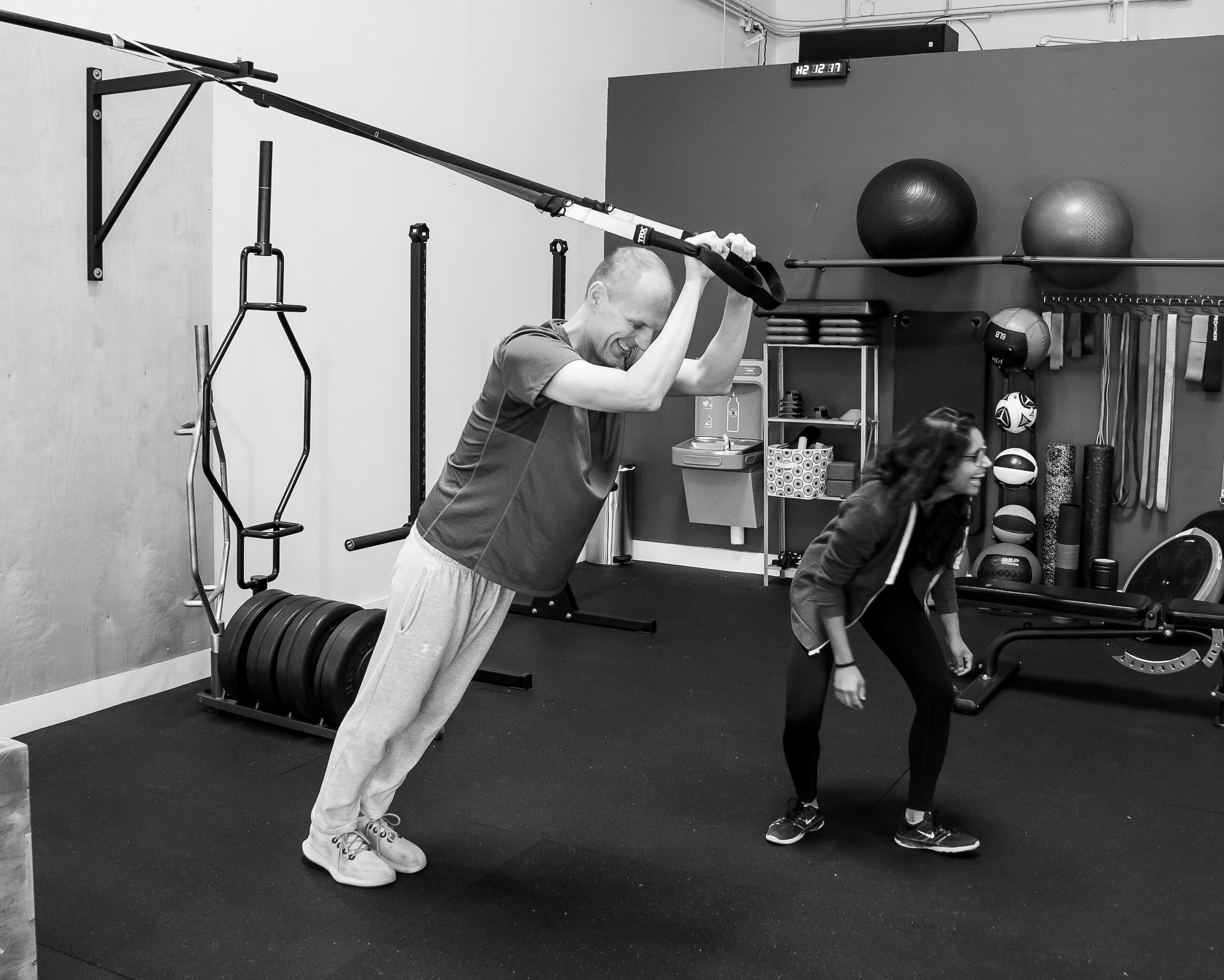
  2. Straight arm plank: The plank is an isometric exercise.  The term isometric means that a muscle is put under tension for a prolonged period in which it remains in static contraction.  This form of contraction is a basic form of resistance training that avoids the risk of injury due to its limited demands of coordinated movements.  The isometric force allows for stress that will elicit an adaption to match the demands put on the group of muscles supporting the spine and hips.  In the case of the muscles surrounding the spine, this isometric exercise is akin to the stabilizing factors the spinal stabilization muscles demonstrate when we stand upright.  Therefore, performing an exercise that mimics standing will aid us in standing up right longer.  To perform the straight arm plank: find an inclined surface and lean forward with your arms extending and holding up your body.  To increase the challenge of this exercise, decrease the elevation of the surface you are supporting yourself on.  Performing this exercise for fifteen to thirty seconds, two to three times per week can significantly benefit your back strength.

Possessing a strong, functional, and injury-free back is something we are not simply born with.  To avoid lower back injury and decrease the time we are out if an injury were to occur, consistent exercises meant to strengthen our back must be done two to three times per week.

Sean McCawley, the founder and owner of Napa Tenacious Fitness in Napa, CA, welcomes questions and comments. Reach him at 707-287-2727, napatenacious@gmail.com , or visit the website napatenaciousfitness.com.
Just Dont’ Hurt Your Back

“All you have to do is…”  If only life were as easy as living the description behind these words.  If this were the case, we’d all be living on Mars. However, I’m sure we’re all aware that life is full of twists and turns we can’t necessarily predict.  In the case of the physical well-being of our spinal health, there are many motions our back allows us to do: twist, turn, bend, pivot, and remain still for a prolonged period.  We can perform all of these motions thanks to the intricate structure of our spine, the nerves that branch out from our spinal cord to our extremities, and the muscles surrounding the spine.  However, once we sleep funny, endure a few five-plus hour plane rides, or turn our heads the wrong way when looking behind us, a section of our spine can tweak out and dramatically derail the physical activities of our everyday lives.

The spine consists of five sections of uniquely shaped bones called vertebrae. These vertebrae encase our spinal cord.  The vertebrae’s specific functions depending on what part of the body the spine is associated with.  The cervical vertebrae of the neck are seven bones stacked on top of each other.  The thoracic group of vertebrae consists of twelve bones that connect the spine to the ribcage.  The thick, sturdy lumbar vertebrae are a group of five bones that are the strongest and thickest of the spinal bones residing between the ribs and hips.  The sacrum is made of five fused vertebrae connecting the spine to the hips.  Finally, the coccyx, or tail bone, has three to five coccygeal vertebrae.

It’s safe to say that most of the population has suffered from a form back pain.  We can’t “just” avoid a few motions throughout our day to ensure our back stays in good condition.  If one section of the back is tweaked, many maladies can ensue.  Ensuring the back is capable of enduring the stresses of our day takes planning, effort, and understanding of the muscles necessary to ensure optimal spinal health.

A combination of stretching, resistance training, and mobility exercises is critical to a healthy back free of injury.  In part two, we’ll cover a few movements that can be done two to three times per week.  Adhering to consistent exercise can significantly help strengthen our back, avoid injuries, and decrease the longevity of an injury if it were to occur.  Remember that weekly consistency of adhering to exercises is the key to a happy and strong life.

Sean McCawley, the founder and owner of Napa Tenacious Fitness in Napa, CA, welcomes questions and comments. Reach him at 707-287-2727, napatenacious@gmail.com , or visit the website napatenaciousfitness.com.
The gym isn’t fun

The other day when I was out and about running some errands, I had the privilege to run into an old friend.  We had connected earlier in the week at the pickleball courts in Yountville.  He mentioned how fun the sport was and how his body wasn’t as stressed after a tennis session.  He added that the few hours he went to play pickleball gave him a great workout.  “I don’t like to work out that much anymore at the gym or a group fitness class because it’s just not fun anymore.  I get bored.”  He added, “But pickleball is something I can go out and play with my wife, my friends, and meet new people while still getting a great workout.  My calorie ring on my fitness watch tracked that I burnt nine-hundred active calories.”

Conversations we have with our personal training clients are similar. For example, an important question we ask clients who are just starting their personal training experience is, “What holds you back from achieving your fitness goals?”  Along with lack of time, not being sure where to begin, and fear of getting hurt, “The gym isn’t a fun place,” is a standard answer.

For some people, entering the same room day in and out is boring.  Visiting the leg press machine that’s still warm from the body heat of the person previously using it can be off-putting.  Waiting your turn for the lat pulldown machine as another gym-goer shuffles throughout their phone sitting on the equipment when you want to get in and out efficiently can be maddening.  Lastly, if there are no parking spaces at the gym, a knee-jerk reaction for a person who already lacks the motivation to get into the gym after a long day of work is to pull a one-eighty, drive home, and avoid the gym altogether. As a result, the gym can lose its appeal.  If it’s a person’s primary source of exercise, these variables can be hard-pressed to keep a person’s interest.

Circling back to my conversation about pickleball with my friend, he mentioned how fun and what an excellent workout his pickleball experiences gave him.  If something is fun, the desire to return to this activity increases.  This demonstrates a potent tactic to stay fit while finding something you enjoy.  For my friend, this new recreational physical activity keeps him outside and running around.

Keeping a fun physical activity is an effective method to stay fit.  However, let’s not forget, recreational physical activities like pickleball require light running, changing directions, and swinging a racket.  These are significant movements that apply stress to the body.  Whether it be a recreational sport, gardening, or playing catch with your kids, the body needs optimal condition to reinforce the longevity of these activities. It’s essential to support such a physical activity with strength training and injury prevention exercises to participate in an activity we genuinely enjoy sustainably. Therefore, a good ratio to hold yourself to is to perform at least one hour of strength training and injury prevention exercise every three hours you participate in your recreational physical activity.

Let’s not forget that recreational physical activity can be a primary form of maintaining our fitness levels.  However, remember that routine exercise has its place in ensuring the body stays strong, balanced, coordinated, and free of injuries.

Sean McCawley, the founder and owner of Napa Tenacious Fitness in Napa, CA, welcomes questions and comments. Reach him at 707-287-2727, napatenacious@gmail.com , or visit the website napatenaciousfitness.com.

Digital Detox

The term detox can be defined as: a process or period in which one abstains or rids the body of unhealthy or toxic substances.  The one-hundred and thirty-eight gram, three by six-inch device the majority of the population wields in their hand every day have unquestionably revolutionized humanity.  Anyone can absorb knowledge from their phones by performing a quick Google search.  Going to the bank, shopping, or trips to the hardware store have been replaced by the revolution of apps available on our phones.

Thanks to our phones, our lives have become so efficient that we don’t have to worry about specific tasks.  However, while our ability to cross boundaries, thanks to our digital money makers improving lives, we also enter into a dependent relationship where we are bound to these small electronic tablets.  Even as I compose this article, I have my phone three inches away from my keyboard.

Cigarettes, chewing tobacco, and alcohol have been identified as potentially unhealthy crutches chronic users can’t live without.  Overusing these items leads to unhealthy afflictions such as cancer, increased stress, and suboptimal lifestyle habits.  There is always a case of a beer or wine within arm’s reach from the kitchen table for some of us.  Cigarette boxes and chewing tobacco cans fit effortlessly into our pockets, making the action of acquiring these accessory items as easy as retrieving our cell phones.  At times, people depend on these items.  Without them, emotions, thoughts, and energy expenditure unravel.  Life can become imbalanced without these items that reside within arm’s reach.  Would we feel the same if we didn’t have our phones by us?  I’d bet we would enter a state of distress if our phones were left in a location over a hundred miles away.

The dependence on external stimuli from our phones can induce tunnel vision.  When there is something humans find effortless and offers a substantial amount of behavior and emotionally stimulating sensation, it’s pretty hard to let go of that treasure.  When we can’t live without certain things, we can forget about other important things occurring in our lives.

We live in a world of saltwater oceans, cloud-streaked blue skies, and rolling hills formed by millenniums of earth’s natural evolution.  These attributes of our world gift us happiness, freedom, and unforgettable experiences.  Sometimes, it’s hard to make it through the day without checking our phone’s texts, emails, and social media’s current events.  Our phones offer entertainment platforms such as Facebook, Instagram, YouTube, and many others that show us pictures and video clips including people performing entertaining acts, animals doing funny tricks, and visions of sought after vacation destinations.  Instead of consistently using our tiny phone screens to look at these experiences, why not put the phone down and take these experiences in for ourselves to get the full effect.  Go outside, take a trip to the coast, and take walks at dusk and dawn to decrease our digital addictions.

Here are a few steps to detox from our digital addictions and focus more on the experiences we can take in to gift ourselves with easy to obtain experiences in our everyday lives:

  1. Put the phone on silent when eating: Whenever you’re at the table eating breakfast, lunch, dinner, or a simple snack, put your cell phone on silent.  Not vibrate.  Not “low ring.”  Not “one beep.”  Put it on silent.  You can even put it in another room.  These moments that allow for periodic experiences where we are only left to the extents of our thoughts can produce ideas that get blocked out by our myopic focus on the small screens of our phones.  Eating brings about tastes, feelings of relief from momentary hunger, and thoughts and memories from previous eating experiences of the past.  Don’t let our electronic devices take these feelings away.
  2. Use post-its: Do you have a computer?  Do you know how to use a keyboard to answer emails?  If so, perhaps you can limit yourself to answering email only from your computer interface.  I can name more people than the number of fingers and toes attached to my body that use their cell phones to type a long, drawn-out email. Nine times out of ten, feelings, emotion, and intellectual sophistication become omitted from an email composed on a cell phone. Why?  Because the screen size is ten times less than a computer monitor, our thumbs must be used on a touch screen with text size mirroring the surface area of an ants body.  No wonder we can’t think clearly in cell phone-produced emails; we can’t see.  Instead of spending more energy typing emails on our phones, make a quick note on a Post-it pad to reply to the party you wish to email and put it on your keyboard. The next time you sit in front of your keyboard, you can put your full efforts into addressing the individual you are reaching out to.  Plus, you won’t be looking at a tiny screen on a device initially meant to call people.
  3. Avoid answering work-related texts after dinner: Sitting down with our family, friends, or even by ourselves usually takes place at the end of the day.  This time of day typically involves a low energy level.  So why not let go of the stresses of all the hard work we endure throughout a full day of work?  The text messages about the various tasks that need to be completed can wait until the following day.  Take this time after dinner to unwind and decompress.

Our phones and tablets offer us a revolutionary form of progressing as a human race.  However, it’s all too often that we forget we used to use a telephone that was connected to our wall in our homes.  Let’s not forget the purpose of these electronic devices.  They give us the privilege to acquire whatever content we want and an advanced form of communication.  At the same time, we can fall into an unhealthy rut of spending too much time on our phones.  Take some time for yourself by stepping away from your cell phone to experience the gifts the world offers us that we have right in front of us.

Sean McCawley, the founder and owner of Napa Tenacious Fitness in Napa, CA, welcomes questions and comments. Reach him at 707-287-2727, napatenacious@gmail.com or visit the website napatenaciousfitness.com.
Performing Exercises Correctly

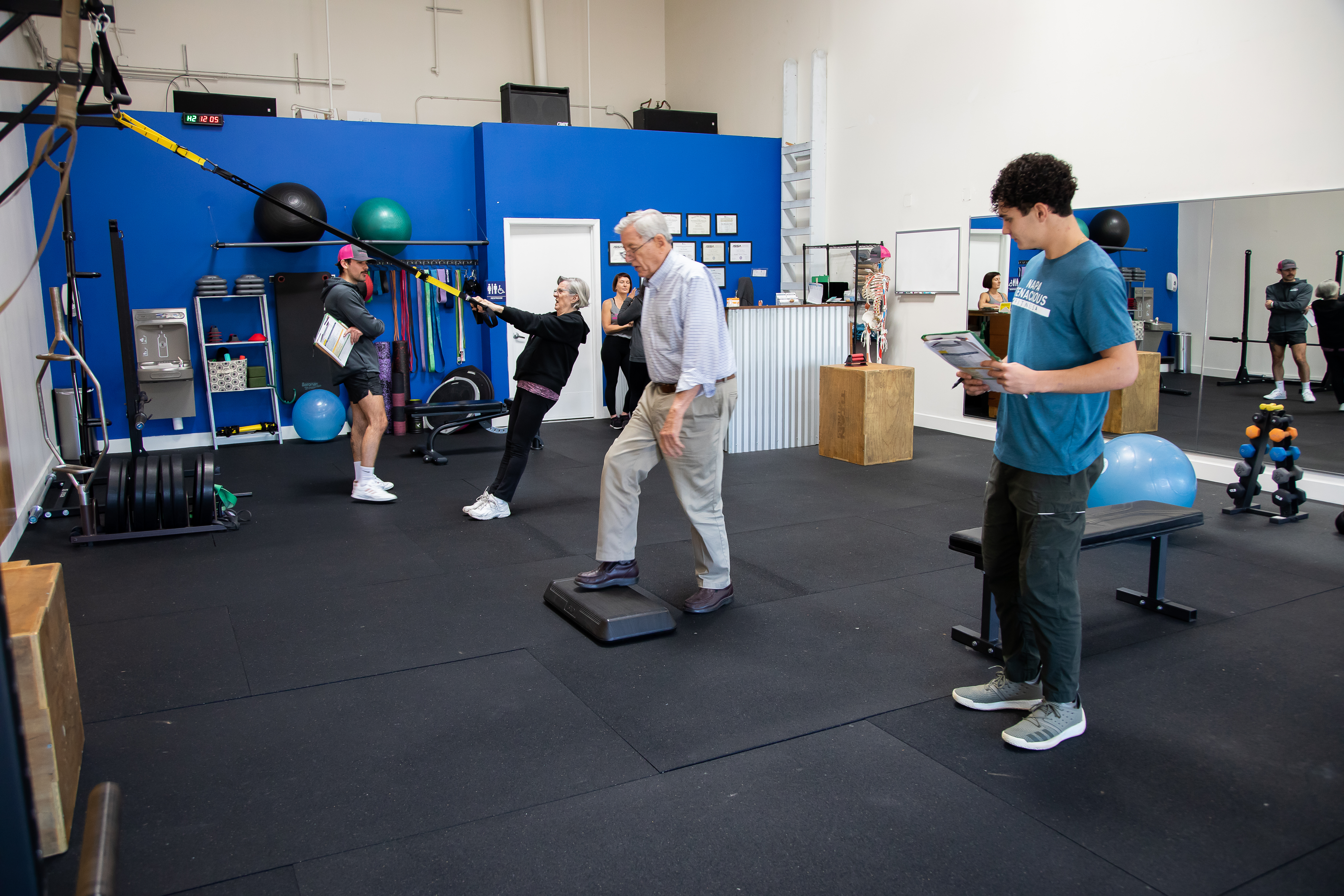
When I was eleven years old, beginning my first adventure on the path of fitness, I was overwhelmed with the idea of getting to lift weights at the gym.  My arrival on the weight floor made me as giddy as a dentist’s child walking through a candy store.  The sensation of wielding a heavy object and manipulating it to move where I wanted to was fascinating.  After a few weeks of using my twig-like arms to perform nothing but bicep curls with five-pound dumbbells, I ventured down the dumbbell rack toward the ten-pound weights then, eventually the fifteen-pound weights.  I was on the road to becoming the reincarnation of Hercules.

Muscle and Fitness and Men’s Health magazines quickly became my version of comic books.  My dad would purchase the newest issue from the magazine rack at the checkout stand of the grocery store and throw it at the door of my room when he had the chance.  Each magazine included copious amounts of pictures of elite athletes, fitness models, and competitive bodybuilders.  This fitness magazine kept me intrigued as to what results I could obtain if I complied with the magazine’s exercise recommendations contained within each edition.

The workouts in my new favorite magazines included six-day workout routines.  Two days for chest and triceps, two days for back and biceps, and two days for legs. Gifted with this treasure map to one day look like Arnold Schwarzenegger pumping iron at Venice Beach, I hit the gym six times a week.

After six months of adhering to this program, I developed what some people would call muscles on my stick-figure-like eleven-year-old frame.  If you ever saw an eleven-year-old flex his gun (known as biceps back in the 90s), you probably couldn’t tell if anything was occurring.  The comparison was akin to the density of toothpicks and dental floss.  However, in my mind, I was a giant who didn’t think he was the man, I knew I was the man.  “Step aside Chuck Norris, there’s a new sheriff in town,” were my thoughts as confidence flowed through my spirit thanks to the navigation of what exercises to perform at my sacred place in the gym.  Not to mention, I was guzzling down the protein powder advertised in each magazine I purchased with my weekly allowance.  This program offered me the physiological improvement and emotional confidence I needed as a young, scrawny, and insecure eleven-year-old developing youngster.

Sounds like an excellent plan for an eleven-year-old who has the time to head to the gym six times a week.  Enter the world of what some would call “being an adult.”  Kids, mortgages, and careers introduce a new challenge to the time we allocate to our daily lives.  With these confounding lifestyle variables, heading to the gym six times a week to work specific body parts laid out in a magazine filled with the fitness models’ training protocols doesn’t seem as attainable as it once was when all we had to worry about was getting home before the sun went down.

As our time is occupied by life’s requirements, our efforts to get into the gym become a challenge.  We don’t have as much time as an eleven-year-old.  However, if lack of time impedes us from performing our much-needed exercise, perhaps we can bolster the quality of our exercise routines by utilizing what time we have available.  A solution to this problem is to focus on exercises that cover a significant area of muscles throughout each movement.  Compound exercises are identified as movements that utilize more than one muscle group throughout an exercise movement. For example, exercise techniques such as squats, pushups, and pulling movements use more than one joint in the body.  This means that multiple muscle groups are being activated at once.

Suppose we can focus on compound exercises and perform them with proper form to accentuate the muscles responsible for these large movements. In that case, we can accommodate multiple muscles groups in one action. Furthermore, performing large compound movements replaces the need to exercise specific body parts on designated days.  Therefore, if time is an issue, choose a compound lower body, a compound upper body pushing, and a compound upper body pulling technique.  These movements can be as simple as the squat, a push-up, and a dumbbell row.  By focusing on the flawless execution of each of these techniques, we can replace the need to hit the gym six times a week.

Allocating an hour to the gym two to three times per week gives us the physiological, psychological, and emotional adaptations to help us live a happy, healthy, and vigorous life.  Make sure to work smart and not hard in the gym to give our bodies, mind, and spirit the attention they deserve.  Set a timer, schedules a day in your calendar, and spend one hour two to three times a week in your preferred gym setting and focus on a full-body routine.  Perform compound movements with impeccably flawless technique to achieve similar, if not better, results than a young and clueless eleven-year-old who has more time than you.

Sean McCawley, the founder and owner of Napa Tenacious Fitness in Napa, CA, welcomes questions and comments. Reach him at 707-287-2727, napatenacious@gmail.com or visit the website napatenaciousfitness.com.
Should I take protein supplements?

It’s been a refreshing experience seeing the Napa community outside enjoying the sun and participating in numerous forms of outdoor physical activity.  The thirty-something-year-old parents can be seen throwing a ball to their offspring with their under ten years old kids.  Volunteer parent coaches stand behind the rambunctious youth as they teach them how to swing metal bats to hit a ball on a tee.  Walkers and joggers frequent the streets dressed in fashionable, cutting edge fitness attire and sporting earbuds as they track their steps to fulfill the requirements of the wearable technology wrapped around their wrists.  As I venture out to the pickleball courts, new participants meander onto the court, learning what this buzzing new psychical activity is all about.  Like the way birds chirp and soar throughout the air as the northern California climate basks its sun-filled, moderate temperature climate, people begin moving more.

As warm weather influences physical activity in our community, a sense of needing to condition our bodies via fitness correlates with this activity. As a result, we see an influx of motivated people who want to refine their fitness by reaching out for our personal training and nutritional consulting expertise.  Nutrition plays a pivotal role in supporting our health and fitness goals.  The community asks us a few popular questions: “How many calories should I consume?” “Are carbs bad?”  or, “Should I be paleo?”  While these questions hold validity to a successful portion in supporting our health and fitness goals, a particular question that strikes my interest is, “What type of protein supplement should I take?”

My immediate response to this question is, “Why do you need a protein supplement?”  This drives my curiosity about what type of physical activity this individual is participating in.  The words “protein shake” bring me back to my internship experience at UC Berkley when I worked with collegiate athletes in the weight room.  These athletes arrived at 6 AM to lift weights for an hour.  They met later that day for speed and agility for another hour.  In the evening, following their speed and agility training, they would meet out on the court or field for sport-specific training.  The conclusion of each of these training sessions was met with the athletes heading to the fridges located in the strength and conditioning center, where they acquired a bottled protein shake.

It came to me intuitively that these young collegiate athletes needed a form of protein supplementation.  Essentially, they were working out three times per day.  Their daily caloric demands superseded those of a general population individual who visits the gym three times a week to perform their own workouts under their own volition.  Perhaps the exercises of a general population person can be slightly more customized if people were to attend a group fitness class led by a fitness professional or a scheduled personal training appointment instructed by a certified personal trainer.  However, even if an exercise session from a general population gym member were boosted by the addition of a professionally designed exercise program from the best personal trainer in town, I would still be hard pressed to believe the physical demands of these workouts would match the intensity of a division one college athlete’s training and athletic activity schedule.

The truth is, we can get many of the vital nutrients responsible for exercise recovery and optimizing muscular growth through the foods we eat in our everyday diets.  Focusing on a diet balanced in carbohydrates and protein from whole food sources can offer more than enough matter to recover our bodies from the workouts we participate in at the local gym or a group fitness class.  Whole food sources are meals that we create on our own instead of powdered protein shakes or pre-packaged protein bars.  In fact, the strength and conditioning staff at UC Berkeley didn’t expect the athletes to get their daily protein requirements from the protein shakes they were supplied. Instead, the coaches made it apparent that it was critically important to eat a substantial source of protein during every meal throughout their days as a student-athlete.

If we wonder if we need to take a protein supplement, perhaps we should look at how much exercise we do.  Are we lifting weights five times per week under five strength and conditioning coaches?  On top of that, are we practicing a sport for two hours per day, five times a week?  If you are, some form of protein supplementation should be applied only if you have already proven that your diet consists of sufficient protein.  Until then, the body will benefit optimally by ensuring to eat meals that have a balanced amount of protein during each sitting.  Let’s not overdo it with worrying about protein shakes.  Focus on what’s in front of us first. After covering protein requirements with actual food first and we need some more, perhaps we can venture into looking for something to supplement our diets.

Sean McCawley, the founder and owner of Napa Tenacious Fitness in Napa, CA, welcomes questions and comments. Reach him at 707-287-2727, napatenacious@gmail.com or visit the website napatenaciousfitness.com.
Daily Hydration Tactics

“How much water should I be drinking?” After completing a seventy-five-minute training session, one of our personal training clients, Ken, asked. “How much do you normally drink each day?” I replied.  “Oh, about two of these.” Ken said after holding up a twenty-ounce portable water container.

Before delving in further to a conversation covering advanced lessons on human physiological water requirements, I wanted to know what tactics throughout the day Ken was conducting for drinking water.  It was immediately apparent Ken wasn’t staying as hydrated as he needed to.  Educating him about minimal guidelines on water consumption would be the low-hanging fruit Ken required to reap the benefits of optimal hydration.  Therefore, it was time to put on my exercise physiologist detective badge.

I asked Ken if he drank any water first thing in the morning after waking up.  A brief “no” was the answer.  My second question was if he can recall what times throughout the day he drank water.  His response was “randomly.”  Third, I asked what other types of liquid he consumed normally in a day.  “Coffee, water, and wine” he replied.  Finally, I asked what his top three favorite foods were, he answered: “Oatmeal in the morning, salad and salmon for lunch, and steak and salad for dinner.”

These interview questions shed light on critical moments revealing opportunities to add more water throughout the day.  The first moment after waking is usually the most dehydrated period we are throughout the day.   We typically don’t consume to much water, after a six-to-eight-hour slumber.  If we drink water “here or there,” these random hydration periods are going to elicit a random hydration status.  The good thing is that Ken was consuming foods with high water levels.  Salad, salmon, and coffee have a high amount of water, contributing to overall daily hydration.  I asked these questions because these scenarios can be efficient reminder cues to consume water paired with everyday events.

Most of the time, we wake up and eat throughout the day.  So, why not pair a full glass of water with these moments?  It’s challenging to meet the recommendations for daily water requirements.  For instance, some guidelines suggest consuming your body weight in ounces.  Whereas other recommendations say ninety-six ounces, or one liter, is an optimal standard to adhere to.   Counting, tracking, and inputting data to ensure we meet our water requirements can get lost in the shuffle with all of the stimuli we endure throughout our everyday lives.  Sometimes, a viable tactic to support consuming more water is avoiding tracking things.  In fact, focus on pairing a glass of water with a particular recurring moment each day.

We recommend a simple and effective strategy to our personal training clients to consume a full glass of water first thing in the morning and after each meal.  This means right after you open your eyes in the morning, grab a bottle of water, a glass of water, or your fancy water tracking bottle and drink it.  Additionally, after you eat breakfast, drink a glass of water.  After you finish your lunch, drink a full glass of water. Finally, immediately following dinner, drink a glass of water.  Before you know it, you’ll be consuming four to five extra glasses of water measuring about twelve ounces each.  This could equate to an extra sixty ounces of water every day.

Hydration is critically important to many facets of our overall health, longevity as humans, and functionality in our everyday lives.  On average, many of us operate in a dehydrated state.  Calculating how dehydrated we are can be a burden to our lives, though.  Instead, focusing on improving our hydration status by regularly consuming water throughout the day is a far more attainable tactic to achieve than meticulously tracking things.  Let’s face it, tracking metrics can be mind-numbing. Instead, use the method of drinking water first thing in the morning and immediately after each meal as a way to invigorate our days without thinking about meeting a specific requirement.  You’ll feel lively, replenished, and ready to perform optimally in your daily life.

Sean McCawley, the founder and owner of Napa Tenacious Fitness in Napa, CA, welcomes questions and comments. Reach him at 707-287-2727, napatenacious@gmail.com or visit the website napatenaciousfitness.com.

Fear of the Gyms

As the weather gets warmer, daylight fills the sky longer, and the first quarter of the year concludes, people begin to settle into new habits.  New jobs, a fest set of classes at school, and new hobbies start to be ingrained in people’s lives.  Along with new year habits, exercises are usually a new tactic society wants to engage in as a regular part of their lives. So, what better way to leave the dark, cold and damp months behind us than by giving our bodies the gift of exercise?

As new inquiries reach out for guidance on exercises and personal training, we discover how raw some people’s relationship with exercise is.  A critically important initial interview question we ask our new exercise participants is, “What does your current exercise routine consist of?”  We get the former athletic and fitness veterans who say, “About two to three times per week. I do a few days at a local gym, maybe some Peleton at home, and I might do a Yoga class.”  When I hear this, I clap my hands.  Good for them.  Conversely, the other side of the new clients we interact with inform us that their weekly exercise status is “Close to zilch.”  This might be alarming, but the number of people who don’t participate in weekly exercise is surprisingly prevalent.

To guide individuals eager to improve health and fitness in a positive direction, we discover what obstacles impede them from achieving their fitness goals.  The popular response is time, work, kids.  Family and financial logistics should prioritize our lives to function as humans in our present society, optimally.  However, some people are just straight-up scared of exercise.  We hear statements from our community that make exercise sound just as terrifying as spilling your coffee on your Armani white button shirt before a job interview.

Entering the sliding glass door of a new gym for someone utterly foreign to this environment can seem like a stepping foot into Jurassic Park.  Gyms impose an intimidating presence.  Taking a tour through the weight room floor after 5 PM could be horrifying for some.   You might find a “bro’d out” group of high school and college age young gentlemen wearing shirts without any sleeves and ear buds in listening to the latest jam.  The visual display of grunting like a wild gorilla while sweating profusely as they press a heavy weight over their head isn’t a rare sighting.  Travelling over to the group fitness class sector, you might come across a few ladies dressed in Lulu Lemon gym attire with the image that they may be entering a gymnastics competition.  One might think those outer brackets of the gym might be a little too advanced. Perhaps the center of the gym could be a little more welcoming.  But, think again, a trip to the center of the gym has rows of steel devices with cables, stacks of cast iron weights, and a seat known as the weight machines. For the rookie gym-goer, one might think they are making a trip to the dentist while sitting in a Transformer.  Jurassic Park, wild gorillas, gymnastic competitions, and large metal contraptions?  I’d be a little scared too if I stepped foot into that world.

What can we do to lower this curtain of gym anxiety?  This is an important question to ask novices in the exercise arena who have anxiety similar to the army of Spartans going into a sea of arrows that blacked out the sun in the movie 300.  One of the first steps is to understand that exercise does not need to be a rigorous event in the gym.  Granted, I have been a gym rat the majority of my life since my dad purchased me a membership to a gym when I was eleven years old.  I felt the gym was my safe place.  However, I can put myself in another’s shoes who view the gym as a jungle.

Performing a full-body resistance training routine using only three pieces of equipment will offer the life-changing responses necessary to a human’s life without having to step foot in the gym.  The trick is knowing what the basic and straightforward mechanisms of exercise can do.  These three items include the ground beneath your feet, gravity, and your body.  Fortunately, if you’re reading this article, you already have those items in your possession.

Exercises such as prolonged walking, hiking, or walking up and down sets of stairs offer your body cardiovascular and strength improving adaptations.  If you want to challenge yourself with a workout, find out what distance you walk, how many times per week, and how many sets of stairs you travel up and down each week. Then, multiply these factors by two.  If you’re only walking one block per day, walk two.  Or if you don’t walk at all, start walking one block.  If you hike once per week, hike twice.  If you don’t hike at all, take a trip to a local park with a slight incline and walk five to ten minutes.

The beauty of the body’s physiology is that it will adapt to the physical demands we expose it to. So, if you’re starting from ground zero, take a look around and see what you have to utilize for exercise.  If it’s a Peleton, a membership to the gym, or a ten pack of Yoga classes, adhere to using those resources at least once each week.  However, if you’re a little greener around the edges, know that you’re not alone.  Just know that your desire to improve your fitness can start right in front of you.

Sean McCawley, the founder and owner of Napa Tenacious Fitness in Napa, CA, welcomes questions and comments. Reach him at 707-287-2727, napatenacious@gmail.com or visit the website napatenaciousfitness.com.