
Osteoporosis can be defined as a condition in which bones gradually lose density and become more porous and brittle over time. As the inner structure of the bone thins and hollows, the risk of a fracture increases. Ordinary daily moments that most of us never think twice about begin to carry more weight. This becomes more pressing as people advance in age. Balance can become impaired, reaction time slows, and the increased risk of falling are a few symptoms that arise as humans age. Exercise can be utilized as a potent medicine to help counteract the undesirable effects of degenerative bone disease. Incorporating safe, consistent, and effective exercise, such as resistance training, helps manage the deleterious effects of age-related osteoporosis.
It may be useful to appreciate that bones are not a dead, static, inanimate object residing in our bodies. Bone is a living tissue with a blood supply and unique characteristics, similar to those of other organs in the body, that respond to how it is treated in everyday life. Much like a muscle, which adapts to a stressful stimulus and grows bigger and stronger, bone responds by resynthesizing, repairing, and reinforcing its structural architecture after a bout of safe, consistent, and effective exercise-induced stress.
Imagine a healthy bone, free of symptoms of degenerative bone disease. That healthy bone is like a towering redwood rooted in the ground at Bothe State Park in St. Helena, with a dense, reinforced trunk anchored deep in the earth and built to sway through storms and hold steady through the occasional earthquake. In contrast, a bone afflicted with a high concentration of osteoporosis is more like a dried piece of cork left out in the summer sun on a hot desert beach on the southern coast of the Algarve region in Portugal. A piece of dried cork tree left out in the hot sun will have degenerated into a light, brittle piece of scrap wood riddled with tiny air pockets that can crack under a force that the redwood would barely notice. While this exaggerated metaphor of osteoporosis might suggest that bones can break under something as gentle as a brisk morning breeze, bones can grow stronger and become more resilient to withstand the stresses of daily human function if trained with intention through a well-designed exercise practice.
While osteoporosis can affect the entire skeleton, hip, femur, and spine fractures tend to inflict the heaviest toll on a person’s mobility, independence, and overall quality of life. Healing after injuries to skin, muscle, tendons, ligaments, and bones isn’t as efficient as humans age. A bone injury in a seventy-year-old has far more implications than that of a twenty-five-year-old. Therefore, the importance of injury prevention cannot be overstated enough when advanced forms of osteoporosis are present in a person’s life. The goal is not to be afraid of movement, but to use movement as our protection.
It should come as no surprise that research continues to support that resistance training is one of the most effective tools available for protecting our bones. A safe, effective, and most importantly, consistent resistance training routine can increase bone mineral density, build muscular strength, and refine balance and coordination. The ability to stay upright and respond to potential threats to balance reduces the risk of falls and reinforces confidence during rigorous daily physical activity.
It also helps to clear up a common misunderstanding. Resistance training is sometimes thought of as the image of a hyper-athletic man with a loaded barbell in a chalky gym full of other alpha males performing heavy squats, deadlifts, and bench presses. Let’s be clear, this isn’t the only form of resistance training.
It’s helpful to think of exercise-induced physical resistance as the thing our muscles push or pull against. Forces of physical resistance can be applied to the body using our own body weight paired with gravity, held in an isometric position, or with elastic resistance bands, a pair of light dumbbells, or a machine at the local gym.
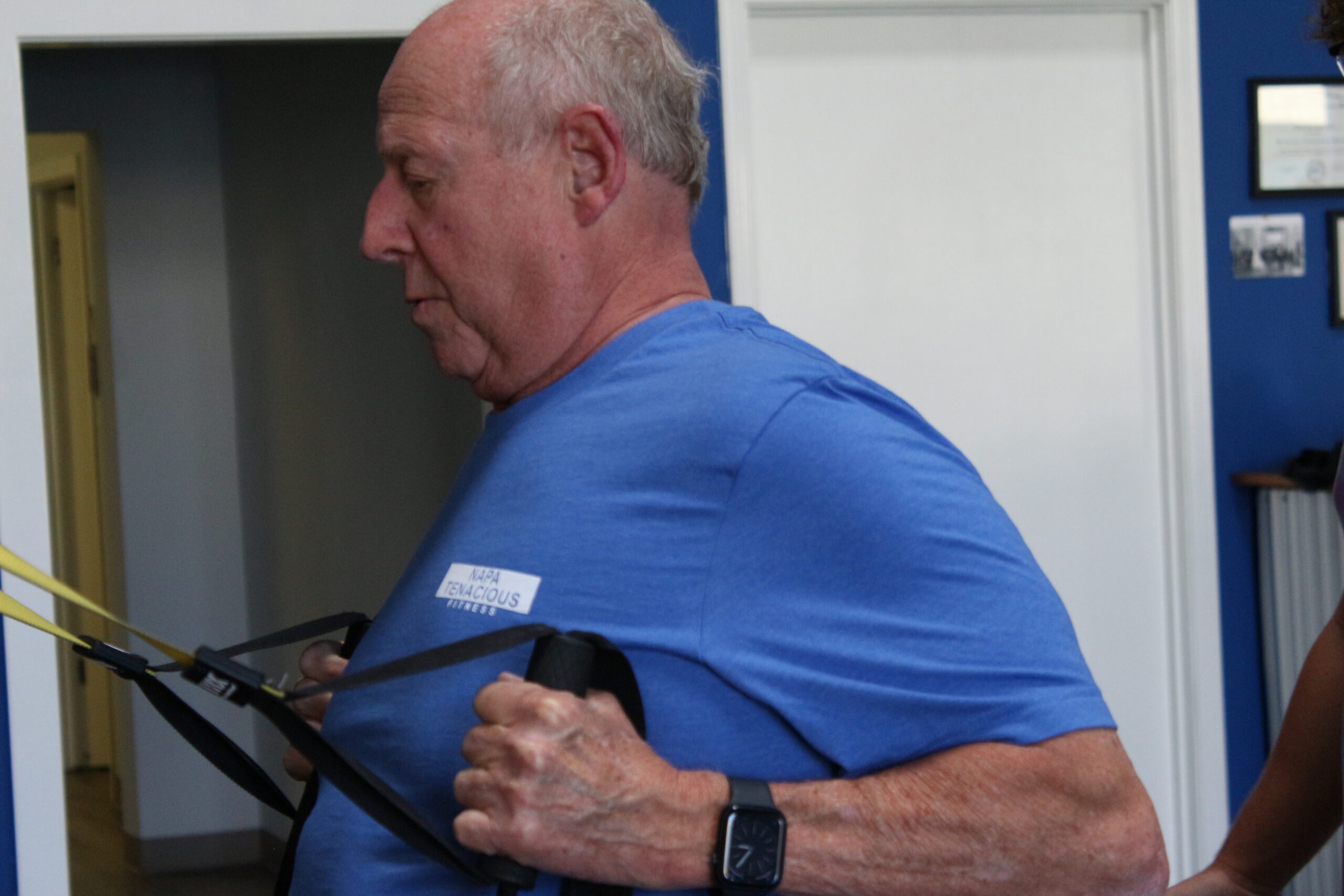
We coach our personal training clients in Napa to rely on compound movements, which engage multiple joints simultaneously. Squats and lunges build the hips, knees, and ankles that carry us through the day. Push-ups and rowing movements strengthen the chest, shoulders, and upper back, and reinforce the muscles and bones of the upper extremities. Planks and other core stabilization exercises strengthen the trunk muscles that reinforce the spine. Resistance training isn’t necessarily defined as lifting the heaviest weights possible. Exercising with optimal technique under an appropriate form of resistance should be a priority to stimulate adaptation in bone tissue.
A diagnosis of osteoporosis does not have to mean the surrender of strength, independence, or the life we love. Our bones are always paying attention to how we treat them. If we treat our bones with respect and listen to the exercises that harmonize best with our bodies, we can live happy, healthy lives while knowing we have strong bones.
Sean McCawley, the founder and owner of Napa Tenacious Fitness in Napa, CA, welcomes questions and comments. Reach him at 707-287-2727, napatenacious@gmail.com, or visit the website napatenaciousfitness.com.