
Have you ever been walking across the parking lot, thinking about the next thing to get done on your to-do list, when the toe of your shoe catches the lip of the curb? Usually, there is a quick stumble, and we might glance around to see if anyone noticed. Most of the time we catch ourselves and keep moving. That little catch is worth paying attention to. It is your ankle telling you how well it is doing its job.
The foot is the first part of the body to react to the ground, and the ankle just above it tends to get taken for granted. The ankle adjusts all day to stepping up and down curbs, stairs, and thresholds while our attention is somewhere else. For those of us who love their pickleball, golf, tennis, and hiking, the ankle is constantly adapting to uneven courts and trails. The strength and control of this small joint play a role in how safe and how smooth our lower extremity movement is.
The tibialis anterior and a collection of extensor muscles run down the front of the lower leg and pull the foot and toes upward. That upward motion is called dorsiflexion. Every time you take a step, these muscles lift the front of your foot so your toes clear the ground. When they are strong, you glide over that curb without a thought. When they decondition, the foot does not lift quite enough, the toe drops, and it catches on the very obstacles you meant to step over.
Dorsiflexion has a partner working on the other side. The calf muscles and the Achilles tendon point the foot downward, a motion called plantar flexion. When you step up onto a stair or drive off your back foot, these muscles generate the push-off that carries you ahead. The plantar flexors are a primary engine of walking. As the dorsiflexors and plantar flexors decondition, push-off fades, the stride shortens, and a shuffle can be present. A strong dorsiflexion to lift the foot and a strong plantar flexion to propel the body forward are what give us a fluid, efficient stride.
There is one more pair of motions worth knowing. The joint just below the ankle tilts the foot inward and outward, called inversion and eversion. This is how the foot adapts to uneven ground. For example, while on a hiking trail, a sloped fairway, or while playing tennis during a quick change of direction, these motions let the foot mold to the surface and keep you balanced instead of rolling an ankle. As the ankle allows the foot to hinge up-and-down and in-and-out, these movements are how the ankle helps us maintain a center of gravity over our feet.
Structured and consistent fitness programs that combine strength and balance exercises can help reduce falls. A lack of exercise puts the ankle joint in a deconditioned state. However, consistently practicing ankle joint strength and conditioning one to three times per week pays far more dividends than an intermittent, random exercise session. Ankle training is also safe, simple, and effective, and it scales to any fitness level.
Below is an exercise we perform with our personal training clients to strengthen dorsiflexion, the motion that lifts the foot to clear the ground. We call it the “leaning-against-the-wall dorsiflexion.”
Start by leaning against a wall with your hips and shoulder blades touching it, your knees slightly bent, and your feet positioned slightly out in front of you. Keeping your heels on the ground, lift both sets of toes upward off the floor. Keep your knees slightly bent and your hips and shoulder blades against the wall throughout the movement. Lift and lower the toes slowly and with control rather than bouncing. You should feel a muscular sensation along the outside of your shins and the tops of your feet. Repeat this movement for ten to fifteen repetitions, and consider two or three sets as it becomes easier.
The human body adapts to the demands we impose upon it. Consistently practicing exercise helps produce strong muscles, joints, and a resilient neuromuscular system. The ankles carry us thousands of steps a day. Perhaps we can give them a few minutes of deliberate attention each week, so we can keep stepping up and over whatever life puts in our path. Strong ankles are an invaluable asset to lifetime fitness, letting us stay on the move on a plethora of unpredictable surfaces, on the court or grass in the recreational sport arena, and on our feet for years to come.
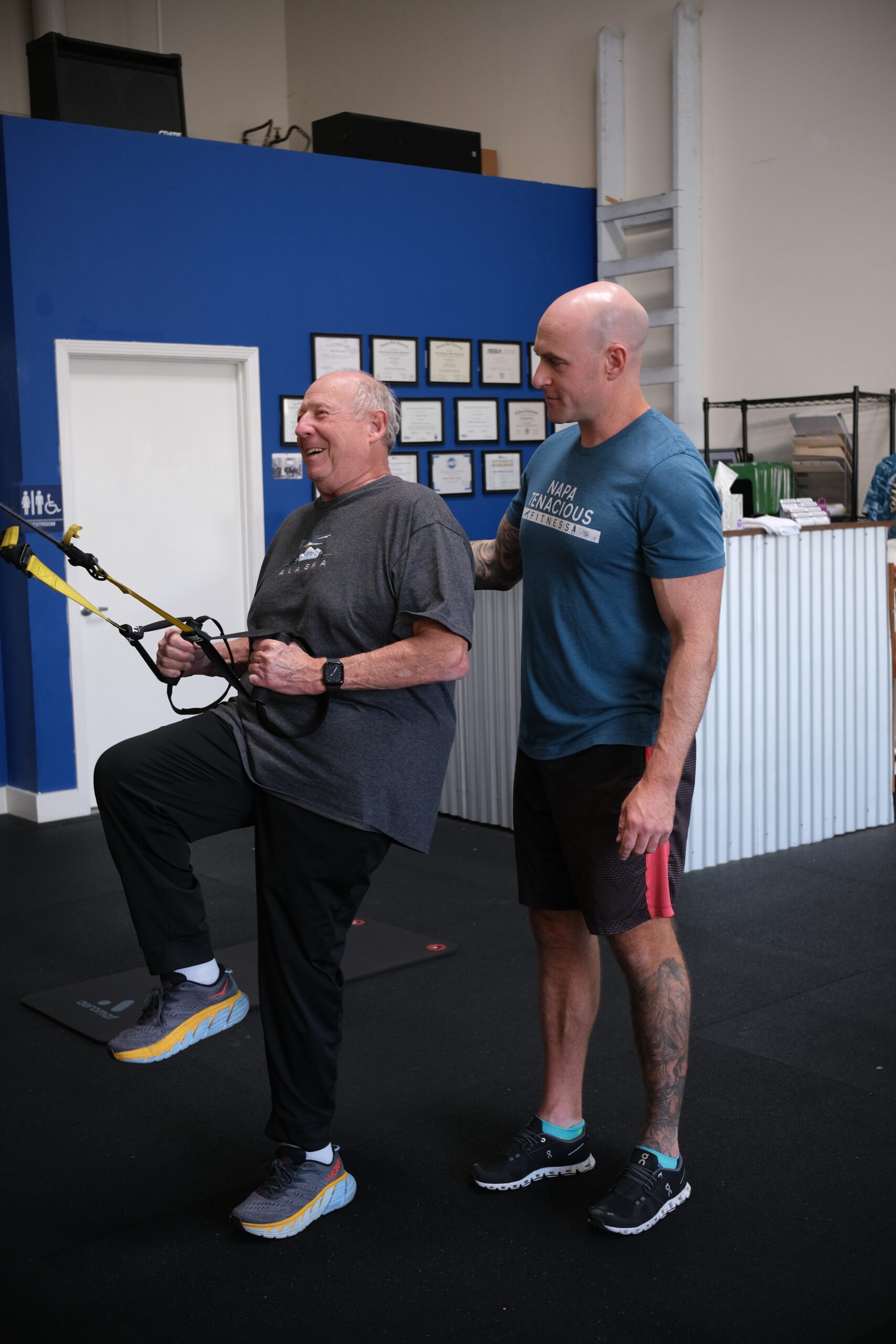
Sean McCawley, the founder and owner of Napa Tenacious Fitness in Napa, CA, welcomes questions and comments. Reach him at 707-287-2727, napatenacious@gmail.com, or visit the website napatenaciousfitness.com.