
“All I did was bend over to pick up a bag of dog food,” Wolfgang explained as he eased himself onto the bench at the beginning of his training session, clearly wincing in pain as he put his hand on his lower back. “I hear about people throwing their backs out moving couches or refrigerators. But, dog food?” Wolfgang’s story is one we hear often. Back injuries tend to occur unexpectedly during everyday movements such as reaching into the trunk of a car, scooping laundry off the floor, or pulling weeds in the garden.
Lower back pain is public enemy number one in the world of annoying, and sometimes debilitating, musculoskeletal ailments. Some of our personal training clients seek out our services to build strength after a lower back injury. A few examples might include recovering from conditions such as bulging or herniated discs, stenosis, or a pinched nerve. Fortunately, the human body responds positively to consistent, appropriately selected exercise by becoming more resilient.
Appreciating the design and structure of the lower back area is a useful tactic for creating a game plan to address common pain points. The lumbar spine consists of five vertebrae stacked at the base of the spine. Those vertebrae anchor into the sacrum, a triangular bone formed by five fused vertebrae that connects the spine to the pelvis. The hip joint is where the thigh bones attach to the pelvis. Understanding how these areas work together and how they become deconditioned helps us protect the lower back before complications arise.
The spine is like the central column of a building, and the surrounding muscles are like the steel reinforcement that brackets it. A concrete column remains rigid not because of the concrete alone, but because of the surrounding steel framework embedded in and around it, sharing the load. The same is true for the spine. On the front side of the body, the deep abdominal muscles and hip flexors, such as the iliopsoas, stabilize the anterior spine and help control pelvic position. Along the back of the spine, the paraspinal muscles run beside the vertebrae like sturdy brackets. These muscles are built for endurance, holding the spine steady hour after hour while we sit, stand, and move throughout the day.
Residing at the center of the body are the gluteal muscles, which act as the anchoring bracket where the spine’s column meets the foundation of the legs. When the glutes are strong and active, they keep the pelvis centered beneath the torso, reinforcing the spine’s vertical structural architecture. The glutes also power hip extension, the motion that propels us forward when walking, lifts us up a flight of stairs, and raises us out of a chair. When the glutes become weak, smaller muscles in the hips and lower back are forced to compensate, which can produce stiffness or pain.
Deconditioned core muscles and inactivity can gradually shift the workload onto less structurally sound connective tissue, which aren’t optimally designed to withstand rigorous physical activity, such as the paraspinal and multifidus muscles along the spine or smaller ligaments of the lumbar spine, pelvis, and hips. The spinal muscles end up doing work better suited to the hips, glutes, and core.
By the time a bag of dog food or troublesome weeds enters the picture and creates a scenario for a back injury, the act of bending over isn’t necessarily the cause of the injury. Sometimes, those simple daily movements in which an everyday tactic results in a lower back injury are the straw that breaks the camel’s back due to deconditioned muscles around the core and hips.
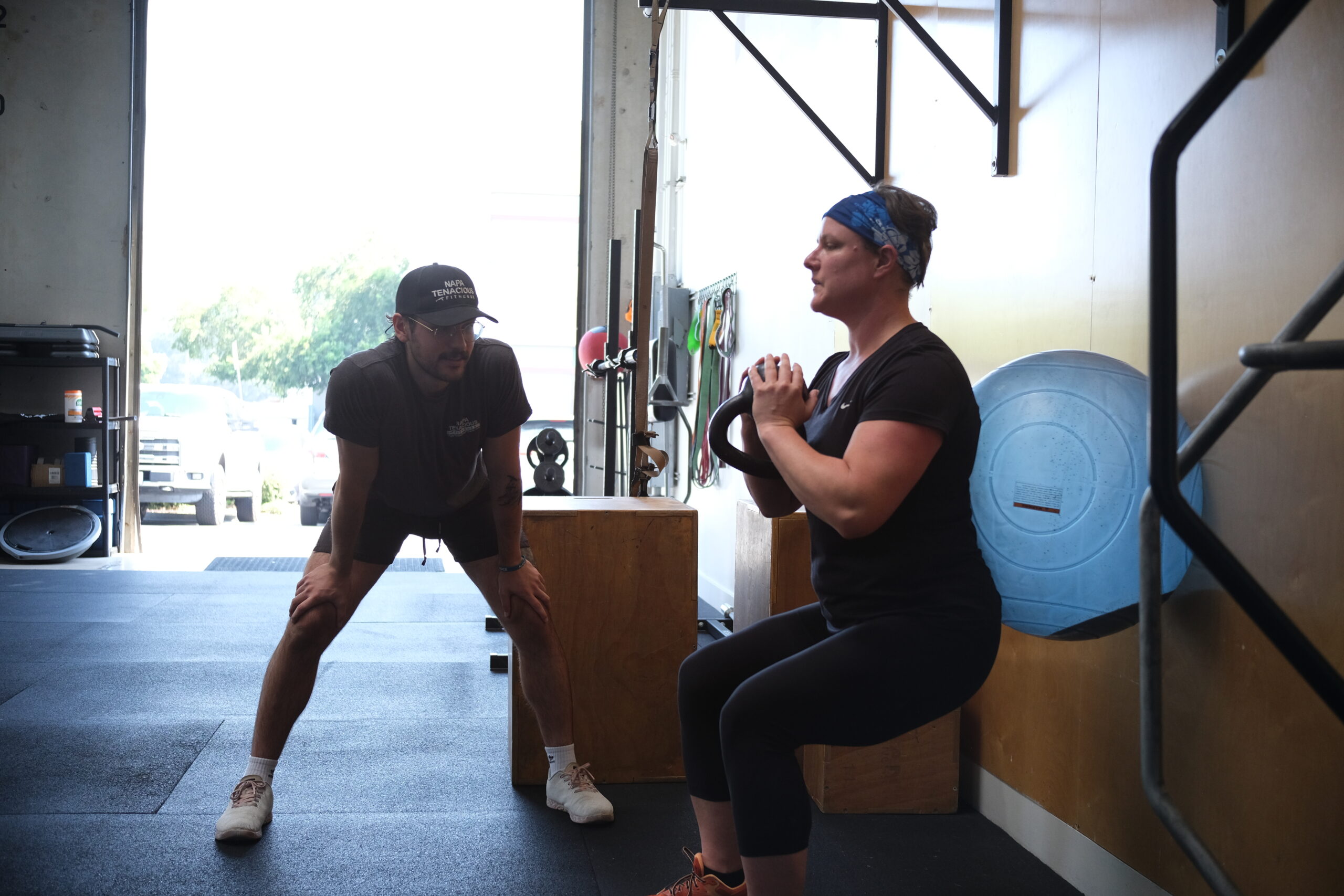
Building a more supportive team around the spine does not require complicated equipment. Regular walking, balance practice, and core stabilization exercises all earn a place in the exercise prescriptions we design for our personal training clients. A simple and effective movement to start with is the sit-to-stand:
To perform the sit-to-stand, begin seated in a sturdy chair with your feet flat on the floor. Reach your arms forward, press through your feet, and stand all the way up until your hips are underneath your shoulders. Then lower yourself back into the chair slowly and with control. Ten repetitions performed two to three times per week is a safe and effective starting point.
The slow lowering portion of the sit-to-stand activates the glutes, hips, and spinal stabilizers to share the workload as a team, rehearsing the skills the body needs when bending down to pick something up off the ground.
Consistently reinforcing the bracketing and framework around the lower back and keeping the spine supported as a sturdy, rigid structure can reduce the likelihood of lower back injuries. When we invest in the muscles surrounding the spine and hips, we give ourselves a sturdy foundation to keep living happy, healthy, and strong lives.
Sean McCawley, the founder and owner of Napa Tenacious Fitness in Napa, CA, welcomes questions and comments. Reach him at 707-287-2727, napatenacious@gmail.com, or visit the website napatenaciousfitness.com.