
Last Saturday, I capped off a productive work week with a ninety-minute pickleball practice session with my friend Nico. After smashing a ball at each other, laughing, and exchanging light-hearted banter, we tapped paddles and commented on the amazing cardiovascular workout pickleball offers. As two gentlemen entering our forties, it felt good to carve out time to practice a sport-specific activity and have fun away from the pressures of our work life and navigating interpersonal relationships.
Nico has about three years of pickleball experience. I have a little more experience since I’ve been playing competitive pickleball since 2018 and have over four hundred tournament matches under my belt. While we both have a similar sense of athleticism, my experience has put me a few skill levels ahead of Nico.
“You’re improving, and it’s fun to see you develop into a refined player,” I told Nico. “It’s been a lot of fun, and I enjoy improving my game.”Nico replied, then shifted the conversation to another topic: “What areas do you think I can get better at?”
A factor I felt was decelerating his progression was his grip on his paddle. Instead of holding the handle of the paddle in the same fashion as a tennis player would hold a racket, he moved his hand up on the handle to where his index finger was on the paddle face, and the other half of the handle wasn’t being used to hold onto. This modification appeared to impede his ability to hit the ball with his backhand.
When a shot went to his forehand, he would cleanly strike the ball and direct the shot to his desired location on the court in precise detail. However, when the ball went to the opposite side of his body, and he needed to turn his grip over to where his knuckle faced the ball and his arm had to cross to his body’s midline, a sense of indecision was present in his body language. His arm would contort to keep his forehand facing the ball, and his typical sense of confidence would diminish when he needed to switch to a backhand swing. Therefore, I told Nico, “Your grip seems to slow you down from working on your backhand.” Nico shrugged his shoulders with a look of dismay. “I have tennis elbow,” he commented. “It hurts my elbow when I use my backhand.”
Tennis elbow is a common painful condition among racket and paddle sport athletes. Also known as lateral epicondylitis, tennis elbow can be defined as an irritation, inflammation, or tearing of the connective tissue at the outer portion of the elbow. The lateral epicondyle of the elbow is a bony prominence located on the outer portion of the forearm, on the same side as the pinky finger, just below the humerus. This bony point is where the extensor tendons of the fingers and wrist originate. The extensor tendons of the wrist and fingers bring the fingers and wrist toward the forearm. These wrist muscles of finger and wrist extension have long, string-like tendons that connect to each finger and the carpal bones below the fingers. With the anchor point being a common tendon attaching at the lateral epicondyle, these muscles act as pulleys to bring the fingers and wrist toward the back of the forearm.
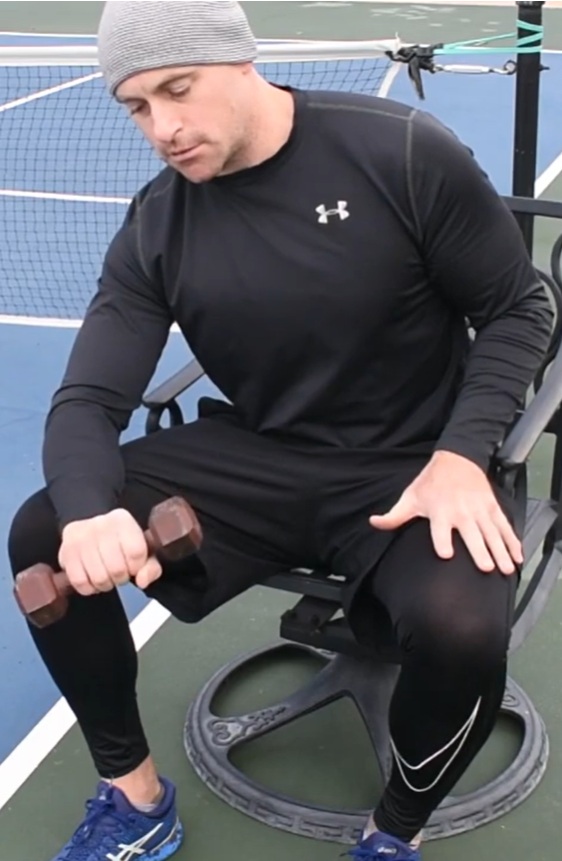
In an effort to manage elbow pain during pickleball outings, I suggested Nico practice an injury prevention tactic we recommend to our personal training clients who experience tennis elbow, the eccentric dumbbell wrist extension:
Hold a dumbbell in one hand, resting on the knee in a seated position. Use the other hand to assist the hand holding the dumbbell in bringing the wrist up to an extended position. Release the hand holding the dumbbell and slowly lower the dumbbell downward for a count of five seconds. Once the hand holding the dumbbell has lowered in a controlled and stable manner, use the free hand to assist the dumbbell hand to the starting position. Repeat this movement on both hands for five to ten repetitions.
It wasn’t Nico’s lack of athleticism or incompetence on the court that impeded his progress. It was the fear of physical pain being produced from using his backhand to strike the ball. The backhand strike in paddle and racket sports requires stability, flexibility, and dynamically coordinated movements from the forearm extensors, which were precisely the areas that Nico felt pain in. It became clear to me that this wasn’t a sport-specific technique issue. It was an overuse injury caused by deconditioned forearm extensor muscles that couldn’t hold up to the demands of standard action in pickleball.
I suggested that Nico add a component of strength and conditioning to his pickleball routine. Something as simple as completing one set of eccentric wrist extensions, a few times a week, to manage tennis elbow pain has the potential to significantly enhance Nico’s pickleball performance.
Sean McCawley, the founder and owner of Napa Tenacious Fitness in Napa, CA, welcomes questions and comments. Reach him at 707-287-2727, napatenacious@gmail.com, or visit the website napatenaciousfitness.com.