
“I have to wear stupid heels when going up and down the stairs. That kills my knees,” commented a client of mine who works as a stockbroker in San Francisco. She was in her fifties, climbing office stairs several times a day in shoes never designed for it, and the pain had settled into her kneecaps.
After a visit to the doctor, she was told that she had an advanced form of osteoarthritis and that the degeneration of cartilage, bone-on-bone compression within the joints, and the advancement of age were contributing factors to her knee pain. She didn’t want to accept that knee pain would dictate the rest of her life, so she signed up for training. Instead of chasing individual muscle groups, we trained coordination, movement through different planes of motion, and the moments when her knees actually hurt. After a few months of consistent strength and conditioning, she was hiking with her family and climbing up and down stairs in the stupid heels with significantly less knee pain.
Osteoarthritis is worth separating from arthritis in general, because other forms work differently in the body. In the knee, it means the smooth cartilage covering the ends of the femur and tibia has thinned and roughened over the years. Resistance training doesn’t rebuild that cartilage, and it isn’t a cure. What it changes is the muscular system surrounding the joint.
The quadriceps, hamstrings, glutes, and calf muscles constantly adjust force to control the knee while we move. These muscles work like a car’s suspension system. Strong muscles don’t eliminate every bump in the road, but they help the rest of the vehicle, which are the joints in our body, manage them. Muscles also work as brakes. Descending a staircase or stepping off a curb requires the quadriceps and glutes to control how quickly body weight travels downward. Better brakes mean better control over how force enters the joint.
The most useful way to think about it might be engine size. If a person’s legs are deconditioned, standing from a chair can require nearly all of their available muscular capacity. However, after several months of consistent strength and conditioning, that same action of squatting up from a chair might require closer to half of the force produced by the working muscles responsible for that specific action. Everyday functional movements such as climbing stairs, carrying groceries, and getting up off the ground become relatively less demanding when a body conditioned through consistent, effective strength and conditioning practice is present.
The nervous system also plays a role. People living with knee osteoarthritis frequently demonstrate weakness in the quadriceps and hamstrings, altered muscle activation, and reduced awareness of where the joint sits in space. For example, when intense knee pain is present, common adaptations to compensate might include stiffening the knee, taking shorter, choppier, scuttle-like steps when walking, favoring one leg, or contracting every muscle around the joint at once. Building strength and control through safe, effective exercise so the right muscles produce enough force can help alleviate joint pain. Compound exercises that require several muscle groups to work together help develop that timing.
Cartilage is less like the rubber tread on a tire and more like living tissue that expects to be used. The cells within it respond to loading, and appropriate movement sends signals that help maintain healthy cartilage. Excessive stress can do the opposite. The old wear-and-tear model can lead us to believe that using an arthritic joint will wear it out faster. It’s worth speaking with a physical therapist or physician about what’s appropriate before starting a new routine.
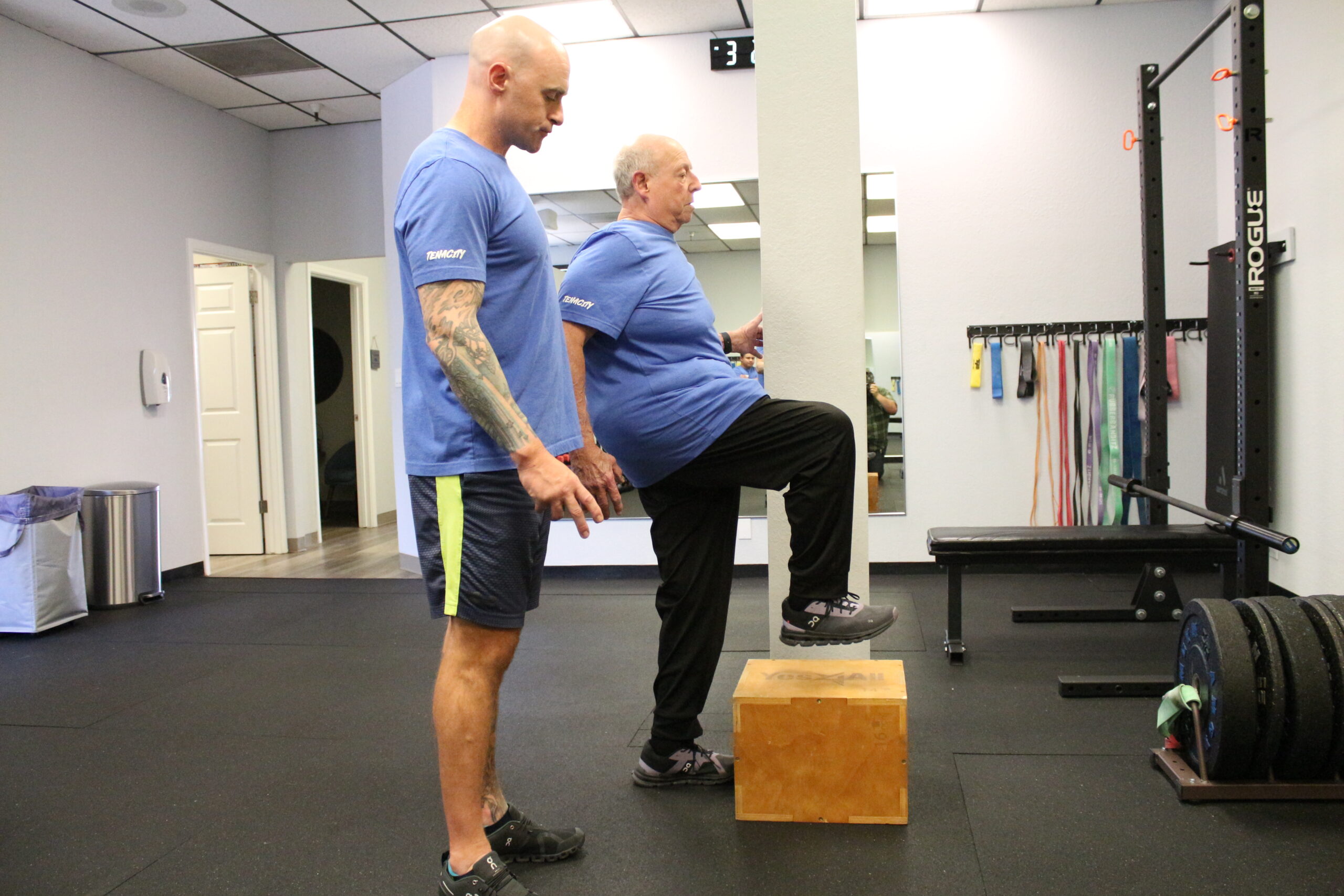
The reverse step-down is a safe and effective exercise we use with our personal training clients to build control on the way down. It trains the quadriceps and glutes to act as brakes, which is exactly what a staircase demands of the knee.
To perform the “reverse step-down,” stand on a low step or curb with one hand on a wall or railing for support. Ensure you are facing the step to emulate a “backward stepping” motion off the inclined surface. Slowly lower one foot toward the ground, taking about three seconds on the way down, while keeping your knee tracking over your toes. Tap the ground lightly, return to standing, and repeat for five to ten repetitions on each leg.
The human body adapts to the demands we impose upon it. Consistently building hip, knee, and ankle strength each week can pay invaluable dividends toward osteoarthritis management. Strong legs can lead to longer hikes, less knee pain when climbing up stairs in stupid heels, and, most importantly, the freedom to keep doing the activities we enjoy for years to come.
Sean McCawley, the founder and owner of Napa Tenacious Fitness in Napa, CA, welcomes questions and comments. Reach him at 707-287-2727, napatenacious@gmail.com, or visit the website napatenaciousfitness.com.