
The ability to stand upright on two feet can be perceived as a normal activity that doesn’t need much appreciation. However, standing upright is an invaluable asset. An example of a pivotal moment in our everyday life is getting out of bed first thing in the morning. This might look like pushing oneself up from a lying position, swinging the feet over the edge of the bed, placing both feet on the floor, and extending the legs to finish in an upright standing position. Whether we literally roll out of bed or put a little more thought into it by strategically following an order of operations to pivot our bodies and gradually get to a standing position, we usually do it without a second thought. We’re able to accomplish this seemingly simple task thanks to the brain’s sophisticated design and the body’s neuromuscular system that operates in an efficiently coordinated manner to bring us to an upright standing position.
Being the most advanced organism on Earth, humans are equipped with a system of a central command center and wiring that gives immediate messages to allow us to interact with our environment by walking forward, stepping side to side, standing up from seated positions, kneeling down, or performing athletic activities such as running, jumping, catching, or a combination of all three. These complex activities are made possible by the body’s skeletal framework, neuromuscular system, and our ability to adapt by refining our skill set and fostering neuroplasticity in our cognitive functioning, enabling us to learn, improve, and develop competency in a physical activity.
A human’s ability to stand upright and travel forward relies on optimal posture, so the spine can remain relatively perpendicular to the ground and aligned with the center of gravity. If the spine flexes or extends too far forward, backward, or laterally, the center of gravity that allows us to be upright can be compromised. A shift in the spine that pulls the body out of alignment with its center of gravity creates a lean in a direction that bends the spinal joints beyond their natural range of motion, hindering balance and increasing the risk for spinal injury. The more the spine veers away from its perpendicular position to the ground when standing, the more balance and coordination are hindered.
I’ve never been to France, but I have studied a little architecture and understand that the Leaning Tower of Pisa isn’t perfectly aligned with the ground. It leans about four degrees out of an ideal centralized foundation. For the leaning tower of Pisa, it’s worked for a few centuries. However, for humans who have a spinal cord encased in vertebrae that both support as a foundational component that allows the body to remain in an optimal center of gravity while also transmitting neuromuscular signals from the brain to the body’s extremities, a spine that leans out of alignment for long periods of time significantly compromises health and everyday life functionality.
A hunched-forward posture shifts the center of gravity anteriorly and causes the spine to bend like a fishing pole with a hooked fish. This not only contributes to a slew of musculoskeletal spinal injuries but can also increase the risk of falling forward. Therefore, ensuring the body has optimal posture when standing and walking is critically important to our health and everyday life functional capacity.
Posture isn’t only important for everyday physical activity, but also critically important for a successful exercise session. Maintaining spinal alignment throughout exercises reduces the likelihood of injury and promotes optimal posture in everyday functional activities. An exercise we conduct with our personal training clients at the beginning of every training session that serves as an injury-prevention and postural-support tactic is scapular protraction and retraction. To perform scapular protraction and retraction:
Lift your arms and bend them at about a ninety-degree angle, aligning your arms with your armpits and fingertips pointing in front of you. While maintaining your elbows at a 90-degree angle and keeping your fingertips facing forward, glide your shoulder blades forward along your rib cage until you feel a stretch in the upper back and a muscular sensation in your pectoral region. Reverse the motion and glide your shoulder blades backward against your ribs. You should feel a muscular sensation in the muscles surrounding your shoulder blades. Repeat this movement for five to ten repetitions.
This exercise promotes strength and endurance in the scapular stabilization muscles. The muscles connecting from the scapula to the thoracic and cervical spine encourage the head to pull back in an upright position, where the skull sits congruently at the top of the spinal column. Performing this simple exercise a few times a week can significantly improve posture, reinforce balance, and help us be more productive and functional in our everyday lives.
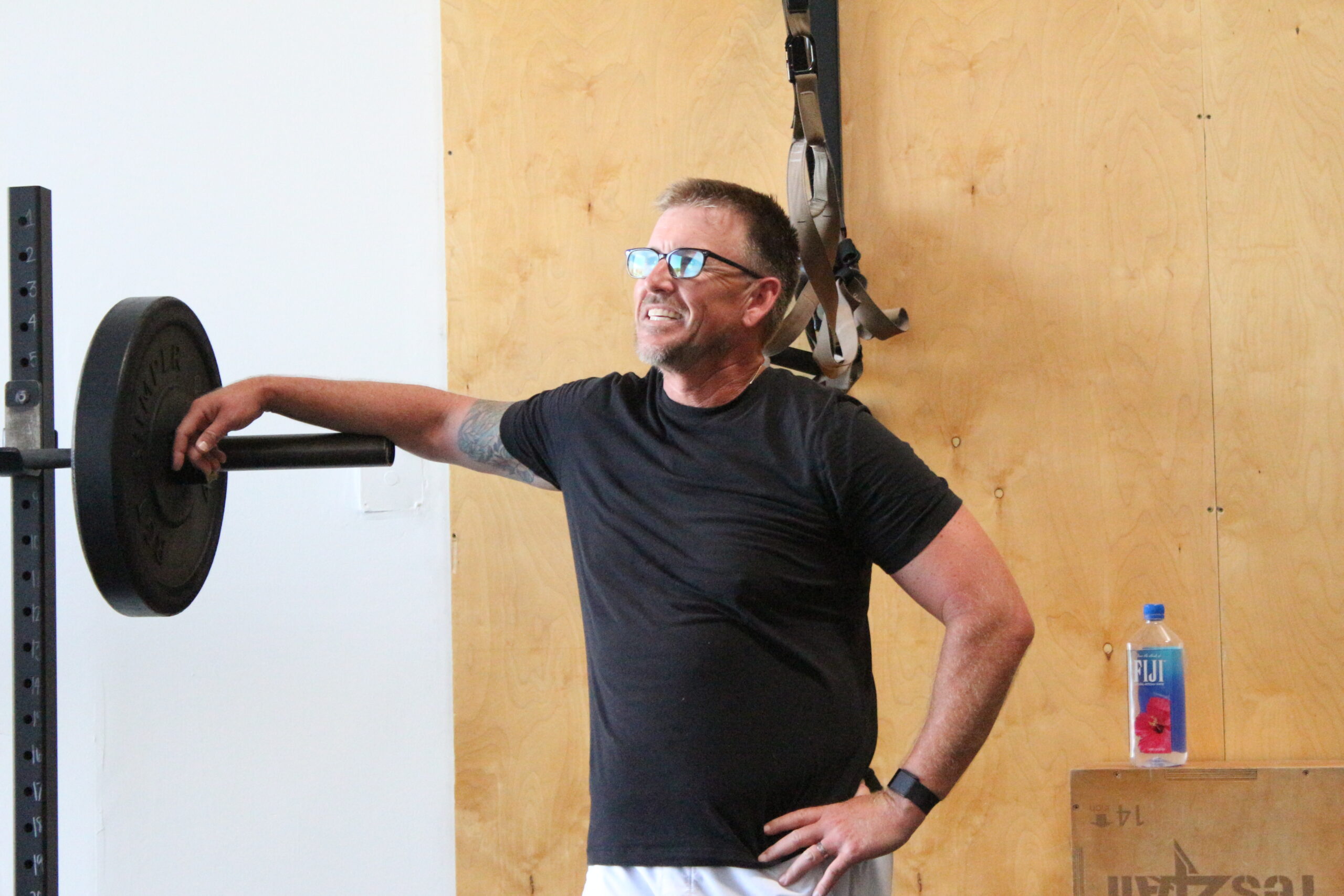
Sean McCawley, the founder and owner of Napa Tenacious Fitness in Napa, CA, welcomes questions and comments. Reach him at 707-287-2727, napatenacious@gmail.com, or visit the website napatenaciousfitness.com.