
Sometimes, the gold standard of “a strong core” can be visualized as a picture of Brad Pitt’s abs in his appearance in the classic movie Thelma and Louise. After taking his shirt off in a display that swooned viewers who were observing a specimen with the muscular body, structure, and proportions of a Greek god, we could see a set of abdominal muscles beneath skin with sub-three percent body fat that looked like they could grate a block of Parmesan cheese. This area of the core, as displayed by Mr. Pitt’s abs, is an important part of a healthy core. However, let’s not forget the other core areas that help optimize everyday human function, such as the muscles surrounding the lateral and posterior aspects of the spine and hips.
Physical movements throughout our daily lives contribute to enjoyable interactions and a sense of fulfillment. Without our ability to move our bodies, suboptimal experiences, including being unhappy due to pain and weakness, can occur in various aspects of our lives, including social interactions, our work life, and even something as simple as getting out of bed in the morning. We depend on our bodies to get up from seated positions, bend down to pick things up off the ground, and interact with our environment from a standing position anywhere for multiple hours throughout the day. If our bodies can’t withstand the stresses of prolonged standing, lifting, and manual labor, our everyday lives might not be as enjoyable due to the challenges of a deconditioned body. The body’s physical, psychological, and emotional health thrives when it is in optimal condition to function in everyday life. An important area that acts as a keystone in supporting a vast majority of everyday functional movements is the core muscles.
The rectus abdominus muscles that create the “six pack”, reside on the front portion of the abdomen. They assist in keeping the torso upright, bending over, and rotating. However, these “six-pack” muscles are surface muscles that act in unison with various other core muscles. The deep intrinsic core muscles of the psoas and hip flexor muscles originate at the anterior portion of the spine, span down the front of the lumbar and sacral spinal regions, and attach to the top portion of the hip. The muscles of the back and hips stabilize the spine and hips, helping prevent lower back strains and contributing to injury prevention in the spine and hips, such as pinched nerves, lower back spasms, or sciatica. These muscles also act as primary movers to pull the torso upright from a bent-over position, to sit up out of bed, to maintain an upright and stable posture while sitting, and to aid forward and follow-through strides in walking and stepping.
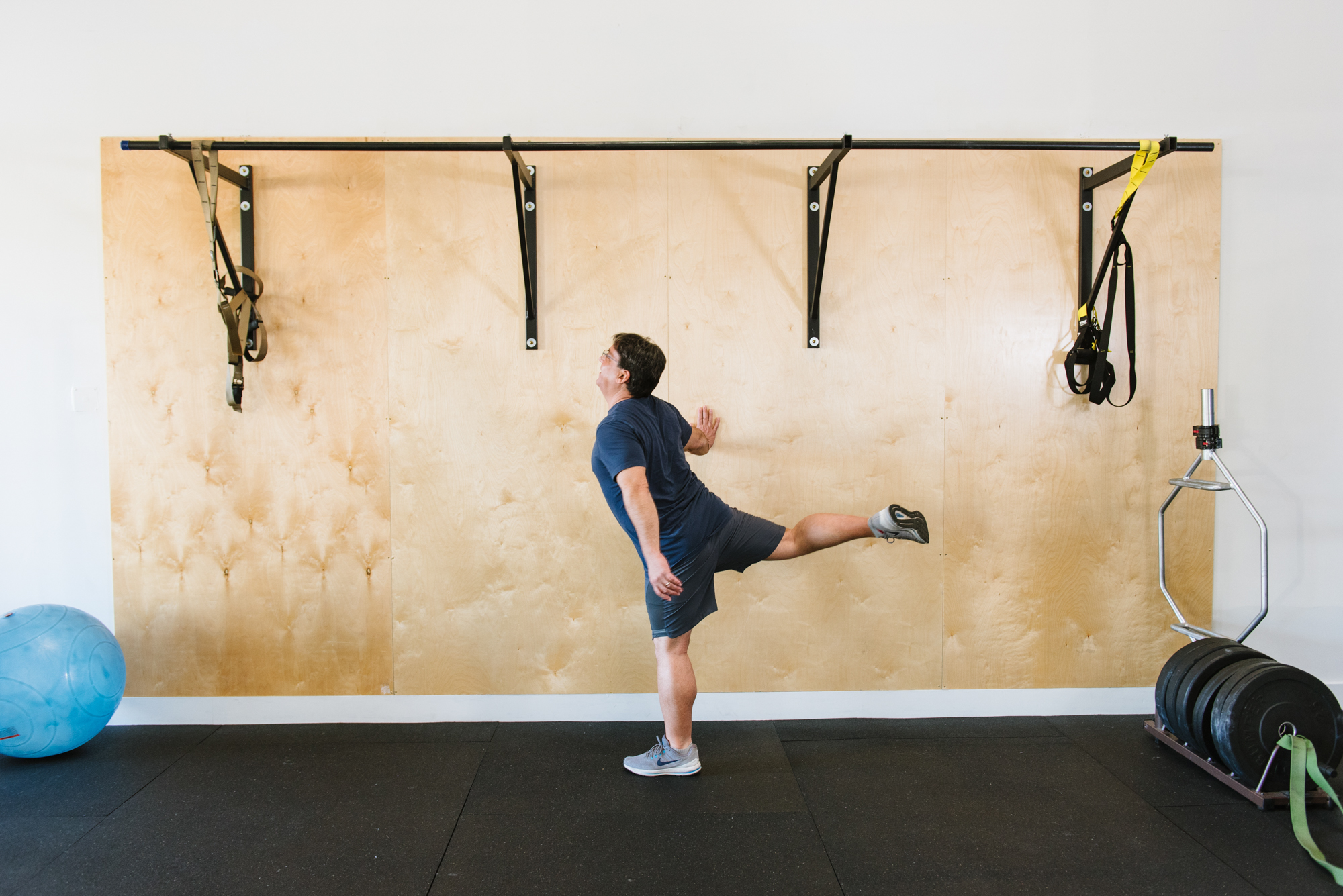
A simple, effective exercise we conduct with our personal training clients at the beginning of every training session is the “leg kick stretch.” This movement encourages the participant to practice bringing the hips forward, working the deep intrinsic core muscles and hip flexors, stretching the hamstrings and posterior chain muscles, as well as rehearsing upright posture by keeping the spine in alignment. To perform the “leg kick” dynamic stretch:
From a standing position, reach your hand in front of you. While keeping your supporting leg straight, actively bring one leg in front of you to touch your hand as if you are performing a kicking motion. Ensure to keep the kicking leg as straight as possible. You should feel a slight stretch in your hamstring. This movement requires balance and coordination. Feel free to stand next to a stabilizing object, such as a wall or a post that is securely fastened to the ground, and place your hand on the stabilizer to assist with maintaining adequate balance. Safety is the top priority during any exercise setting. Perform this movement for five to ten repetitions on each leg.
For some of us, we may not understand how important a strong core is until an injury presents as a pinched nerve, a bulging disc, or a nasty case of sciatica. We don’t need the washboard abs of Brad Pitt in his prime, which he worked to develop for one shoot in an award-winning Hollywood movie, to have strong core muscles. Brad probably put in hours of aerobic exercise, a few thousand sit-ups a day, and ate nothing but lean proteins and salads for twelve weeks to prepare for a single shot. However, adhering to a consistent exercise routine at least once per week that reinforces the infrastructure of our spine and hips is a key ingredient for helping us live in less pain and enjoy our everyday lives.
Sean McCawley, the founder and owner of Napa Tenacious Fitness in Napa, CA, welcomes questions and comments. Reach him at 707-287-2727, napatenacious@gmail.com, or visit the website napatenaciousfitness.com.