
Our brain is encased within the skull and sits atop the first vertebrae of our spine. Featuring the central command center in which all of the decisions to send electric signals down our central nervous system to our organs and muscles, the brain is arguably the most important part of our body. Without it, we can’t do much. It should go without saying that the brain is a noteworthy organ that deserves care. The cervical vertebrae are a collection of seven uniquely shaped spinal bones forming the neck. The skull sits atop the seven cervical vertebrae. Featuring the ability to tilt the skull up and down, rotate side to side, bend laterally, glide forward and backward, and rotate in a gimbal-like fashion, the cervical vertebrae serve as an integral part of protecting and holding the head upright.
A network of cervical stabilization muscles connects the cervical vertebrae to the skull, connects each cervical vertebra, and connects the cervical vertebrae to the clavicle and shoulder blades. These muscles are critical for granting structural support and powering the mechanical movement of the neck. Ensuring these muscles are conditioned and managed to operate optimally enables the neck to function with less distraction of pain, tightness, or weakness.
The muscles, tendons, and ligaments that attach the skull to the cervical vertebrae provide structural support to maintain optimal alignment of the skull on the cervical vertebrae. These neck muscles also serve as motors not only to move the head in various directions, but also to act as isometric stabilizers, keeping the skull in an uncompromised position. However, when these muscles are damaged by a previous injury or deconditioned due to poor exercise adherence, the integrity and functionality of the neck can be significantly compromised. If our neck can’t hold our skull in proper alignment, one could imagine the ability to see, smell, hear, or taste could be hindered if we can’t keep our head upright.
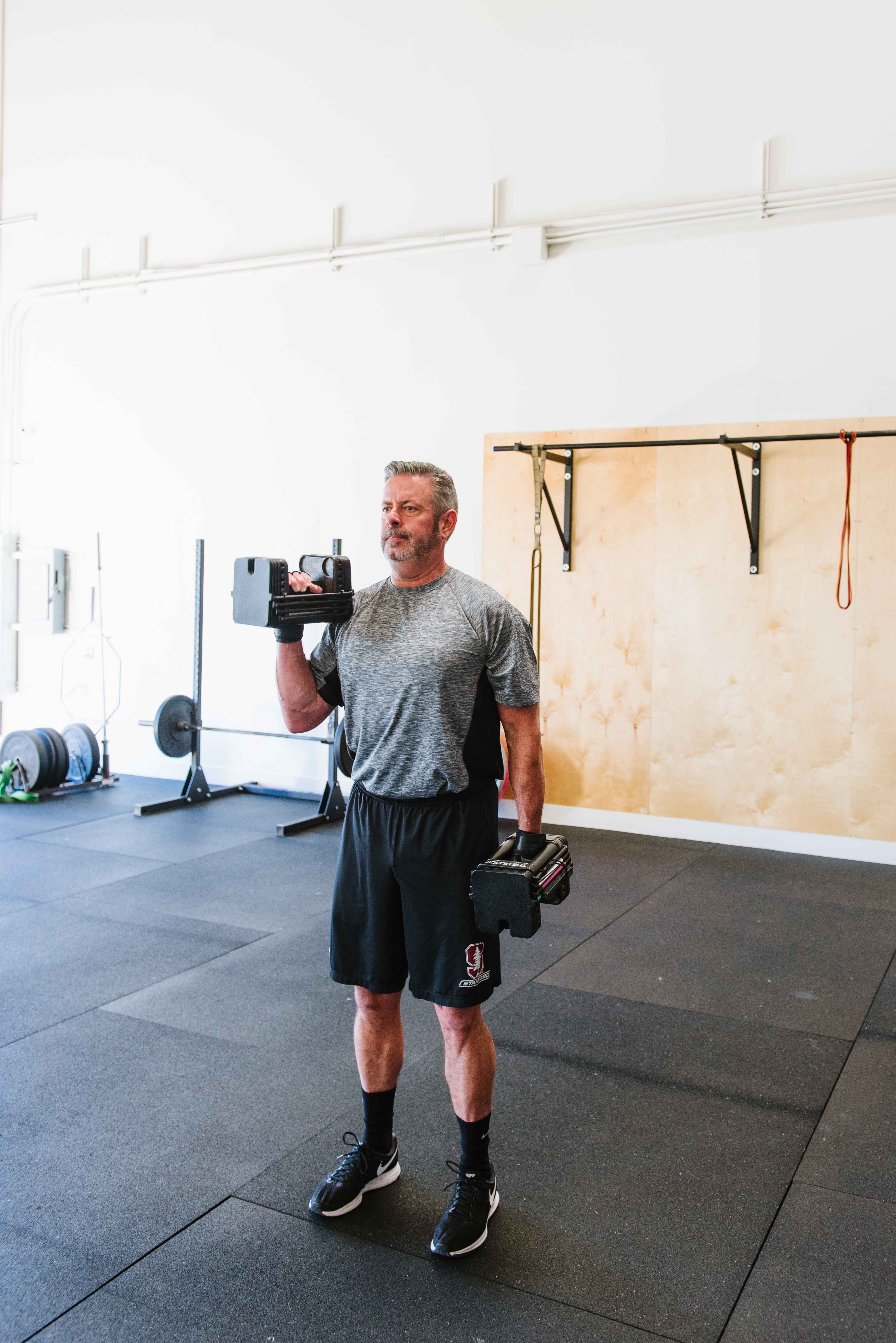
A cue we give our personal training clients throughout their training sessions is to “keep the arm pits over the hips.” We get some puzzled looks when we mention this to our new exercise participants, who hear this odd terminology for the first time. However, the cue pertains to ensuring a strong, well-supported posture to avoid injury and to reinforce healthy habits in their everyday lives.
Imagine looking at a human body in the lateral plane, or the side of a person’s body. This would be viewing someone to see the right or left side of their body. If a person has a curved back in which their head is stooping forward, the spine is bending akin to the structure of a fishing pole, which applies tremendous strain to the muscles of the back, the discs within the back, and the nerves that bud out of the spine to innervate the body’s organs. This “hunch back” position creates undesirable conditions, leading to pain and dysfunction in everyday activities. More often than not, this posture demonstrates that the armpit region isn’t lined up over the hips.
“Keeping the armpits over the hips” can be cued in both sitting and standing. While viewing the side of someone’s body, draw an imaginary line from the ground that travels straight up through the heels, knees, hips, torso, armpits, and ears. If a person stacks their body upright and lines those reference points in a straight line, their armpits will likely be over their hips, and a curve in the back won’t be as pronounced. However, if the arm pits slouch too far forward anteriorly, a slumped forward curvature of the back is likely present.
Adhering to an exercise routine one to three times a week can significantly improve function and reduce the likelihood of back and neck injury. A strong core and well-conditioned muscles supporting the body’s major joints are an integral part of being healthy and fit. However, let’s not forget these small, yet invaluable cues, such as standing up straight, looking forward, and “lining the armpits over the hips” to refine our lifetime fitness efforts.
Sean McCawley, the founder and owner of Napa Tenacious Fitness in Napa, CA, welcomes questions and comments. Reach him at 707-287-2727, napatenacious@gmail.com, or visit the website napatenaciousfitness.com.