
Balance can be defined as the ability to stand on one leg, regain one’s center of gravity after losing it, or walk in a straight line. Depending on specific circumstances, balance can significantly impact a person’s quality of life. Sometimes, people in deconditioned states of fitness find the seemingly simple act of getting up from a sitting position and standing up to be an activity that presents a slew of balance challenges. Fitness goals, such as mastering the skill of standing on one leg for an extended period, can be a moderate to challenging goal for most members of the general population. For hyperathletic individuals in whom balance comes naturally, dynamic activities such as squatting or jumping on one leg are another goal of balance.
As professionals in the coaching and personal training field, who have offered our services to individuals at various levels of health, ranging from individuals recovering from injury or surgery to elite athletes, our fitness center has witnessed a vast array of balance levels among our exercise participants. One of the most important factors that has aided exercise participants in improving their balance is to meet them where they are in their current level of balance and apply appropriate progressions. To build strength in the core, hip, knee, and ankle muscles, a safe and effective exercise regimen offering an appropriate amount of challenge is integral to promoting strength, skill, and confidence in a person’s balance.
A critical success factor for improving balance is to identify and address imbalances in the body. To discover levels of imbalance and determine the most appropriate exercises to address them, it’s essential to understand the presentations of imbalance that pose challenges in everyday life activities. For the individuals in their mid-forties to mid-fifties blessed with their offspring blossoming into ages six to twelve years old, there might be a few other young energetic humans running rampant in various settings we’re usually not used to having such boisterous activity in. For example, if a young human is chasing after a ball, playing tag, or practicing their first base slide on a hardwood floor in our homes, the need to evade a human who has now made their body into a projectile might arise in a short amount of time. Therefore, the ability to change direction immediately, move one’s feet from one area to another in a split second, or possibly hop, skip, and jump without thinking twice might need to happen when we least expect it. These activities to evade dangerous situations and regain balance are crucial for preserving one’s health and avoiding a devastating injury.
Regaining balance after a scenario that causes a presentation of imbalance can’t be overstated. The action of immediately jumping out of the way of a moving object travelling directly at a person at a speed threatening to one’s health produces a need to recover from an imbalanced state. However, regaining a safe and steady position after a sudden jolt of needing to evade a physical object colliding with the person is equally important. Mastering the ability to stand on one leg for ten to thirty seconds is challenging. Once that tactic has been mastered and a person can stand on one leg for thirty seconds without having to adjust their balance or fatiguing, another appropriate progression would be to add a type of movement that requires the body to dynamically introduce a presentation of imbalance and then recover from it for a certain number of repetitions. A relatively moderate to advanced balance-based exercise that we instruct our personal training clients to perform is the lateral step over. This movement not only helps with lower body functional strength but also aids in regaining balance from lateral presentations of imbalance.
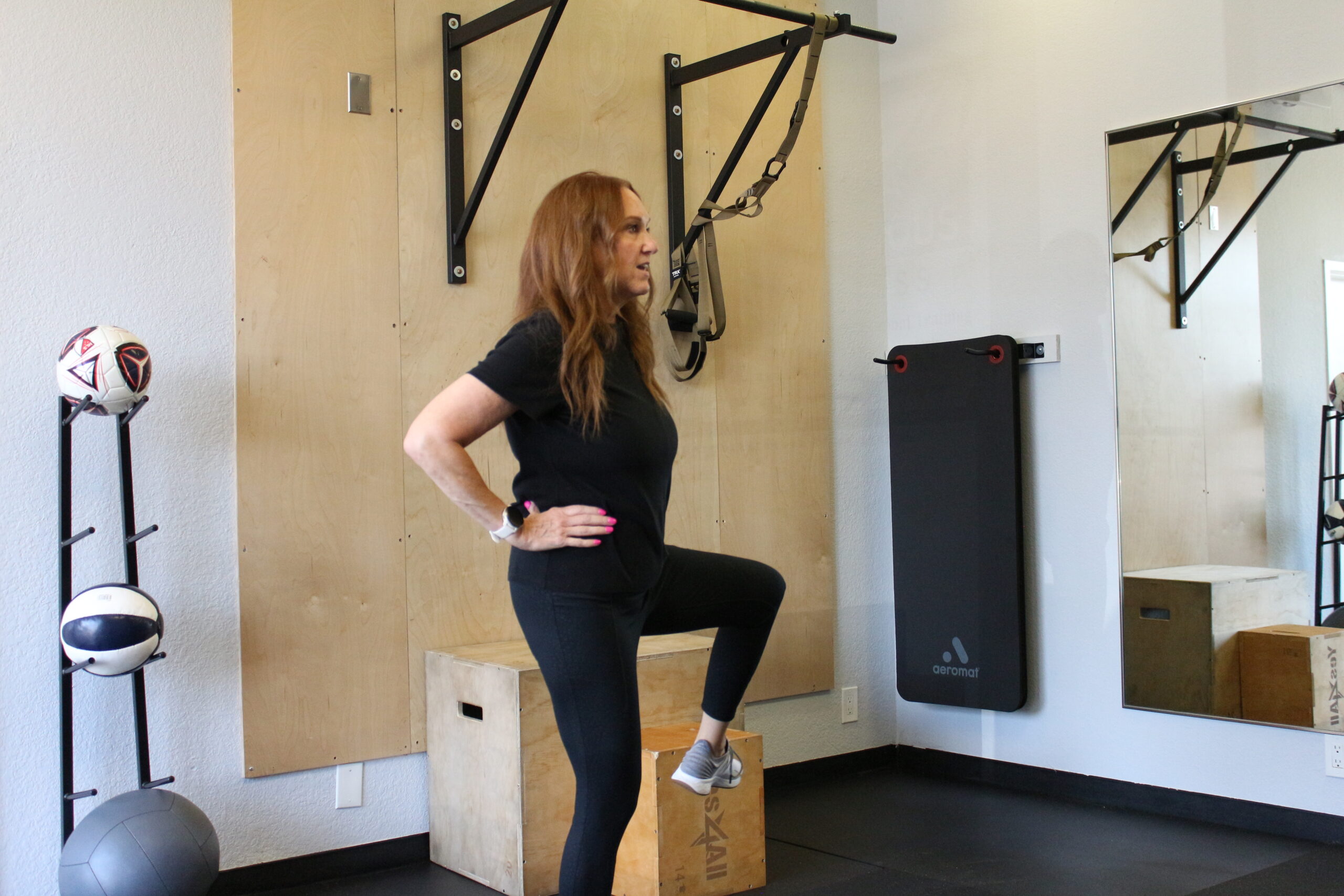
To perform the lateral step over, stand to the side of an object that is about mid-shin height. Lift the foot closest to the object and step over it, landing on the opposite side. Situate your balance on the foot that just landed, then lift the trailing foot up and over the box to land beneath your hips on the other side of the box. It’s important to ensure the toes are high enough so that they do not scrape the top of the object. Repeat this movement on both feet for five to ten repetitions.
The action of shifting the weight from one side of the body to the other, moving the feet laterally or backwards at a faster-than-normal speed, and planting the feet and decelerating from a fast-twitch movement is an important part of balance that is commonly overlooked. Balance isn’t just demonstrating the ability to stand in a static position. Optimal balance also includes the ability to recover from an event that causes the body to shift from one location to another and requires regaining balance.
Sean McCawley, the founder and owner of Napa Tenacious Fitness in Napa, CA, welcomes questions and comments. Reach him at 707-287-2727, napatenacious@gmail.com, or visit the website napatenaciousfitness.com.