
“So, when do I get to use the dumbbells?” said Blaze, as she passed by me in between her sets of completing a round of step-up exercises. Caught off guard slightly by this question as I was attempting to avoid electrocution during some maintenance work in the gym as I was doing my best impression of an electrician changing a light switch, I replied, “I suppose we can look into the previous exercises you’ve completed these past few months and evaluate what the most appropriate next steps of exercise progression would be for you during future workouts.” Blaze paused, making eye contact and absorbing the conversation. I added, “It’s important that you demonstrate mastery and competency in the techniques the coaches have prescribed to you.” Blaze nodded as I continued, “For example, once those step-up exercises you’re performing on a fourteen-inch step look absolutely flawless, we’ll put some dumbbells in your hands.”
Blaze has been an exercise participant who has engaged in our services for over six months. As a busy executive at the peak of her career, preparing to retire in her mid-fifties, she utilizes our services to schedule appointments that can’t be interrupted by her busy schedule. She shows up on time, has a flawless attendance record, and even though she travels throughout the states and internationally for business endeavors, she always communicates with the coaching crew to ensure she attends her twice-weekly training sessions. Equipped with a few musculoskeletal maladies that have resulted from previous sporting injuries, the development of lower back, hip, and knee arthritis, and a schedule that creates enough stress-induced pressure to make a rice cooker explode, Blaze has a flawless compliance record when following her coaches’ instructions throughout her training sessions.
So, why haven’t we put dumbbells in Blaze’s hands yet? She’s a stud muffin of a personal training client, and she pretty much has a 4.5 GPA when it comes to listening to the coach’s instructions and cues, which reinforces that showing up is a critically important component of achieving successful outcomes throughout a fitness journey. As much as I emphasize the importance of compliance, adherence, and consistency in an exercise program for achieving positive outcomes in a person’s life, quality of exercise performance is a key component in advancing toward more sophisticated and challenging exercises.
The idea that challenging the body through safe and effective rigorous forms of physical activity induces a positive adaptation in muscular size and strength development is a commonly understood principle that people usually don’t need to be reminded of. However, exercise is a very risky activity to participate in. In other words, entering any exercise arena, whether it is self-led, in a small group fitness class setting following the lead of a fitness instructor, or under the supervision of a certified and experienced personal trainer, needs to be approached with caution. A thorough review of potential exercise-induced risk factors is necessary. Unfortunately, it’s not uncommon for exercise participants to endure injuries from a training session. Exercise-induced injuries are the last place anyone should experience a strain, sprain, tear, or, at worst, a traumatic injury in which someone falls or has something fall on top of them.
If there could be a takeaway message for reinforcing the importance of participating in more challenging exercises, it would be to understand that form, technique, and focus are just as, if not more important, than paying your taxes on time. Using Blaze’s step-up exercise as an example, the optimal form of a step-up involves standing in front of an inclined surface, such as an aerobic step, curb, or stairs with a height ranging from three to twelve inches, while being mindful of the body’s starting position. Feet should be forward, with the toes perpendicular to the inclined surface, hips underneath the rib cage with the gluteal and core muscles engaged, armpits should be over the hips, and the neck should be aligned by ensuring the ears are lined up over the armpits. After an organized posture has been established, one foot needs to stride forward onto the step, ensuring the heel and balls of the feet are placed on top of the box and pressure is evenly distributed between those points. Additionally, the shin should be slightly glided forward before doing any stepping-up movement. After establishing the position of bringing the foot to the inclined surface, the pressure distributed on the heel and ball of the foot should be “pressing through the floor” as the body steps up onto the inclined surface, ensuring an organized posture is efficiently established throughout the movement. This may seem like an earful to comprehend the dynamics of a seemingly simple movement, such as stepping up onto a surface that is only a few inches high. However, if an exercise participant in our fitness center doesn’t demonstrate they can do these movements, there is no way any of the coaches are going to put a weight in the exercise participant’s hands.
If a simple step up is performed without following protocols of demonstrating optimal posture and foot pressure placement, potential compressive forces occurring throughout the spine, knee, ankle, along with many other risk factors, are more likely to occur. We enter into a situation akin to walking through a warehouse full of kerosene while smoking a cigarette if we add two ten-pound dumbbells to the exercise participants’ hands while they are performing the exercise incorrectly. If the neck, thoracic, and lumbar spine are bent forward when they should be aligned in a rigid-rod-like position without weights in the exercise participants’ hands, an additional forward force from the dumbbells will cause the spine to bend forward even more. If the heel is not pressing through the inclined surface and only the front of the foot is producing the pressing motion, overly compressive forces are applied to the knee joint, producing suboptimal friction throughout the knee joint and hindering balance while stepping up and down.
Conducting resistance training effectively can’t be overstated. Before grabbing a set of dumbbells, take a few weeks to practice exercise tactics to ensure the exercise can be performed safely, efficiently, and effectively. After feeling like you’ve gotten the “gold star” sticker on your performance, maybe it’s time to grab a set of dumbbells.
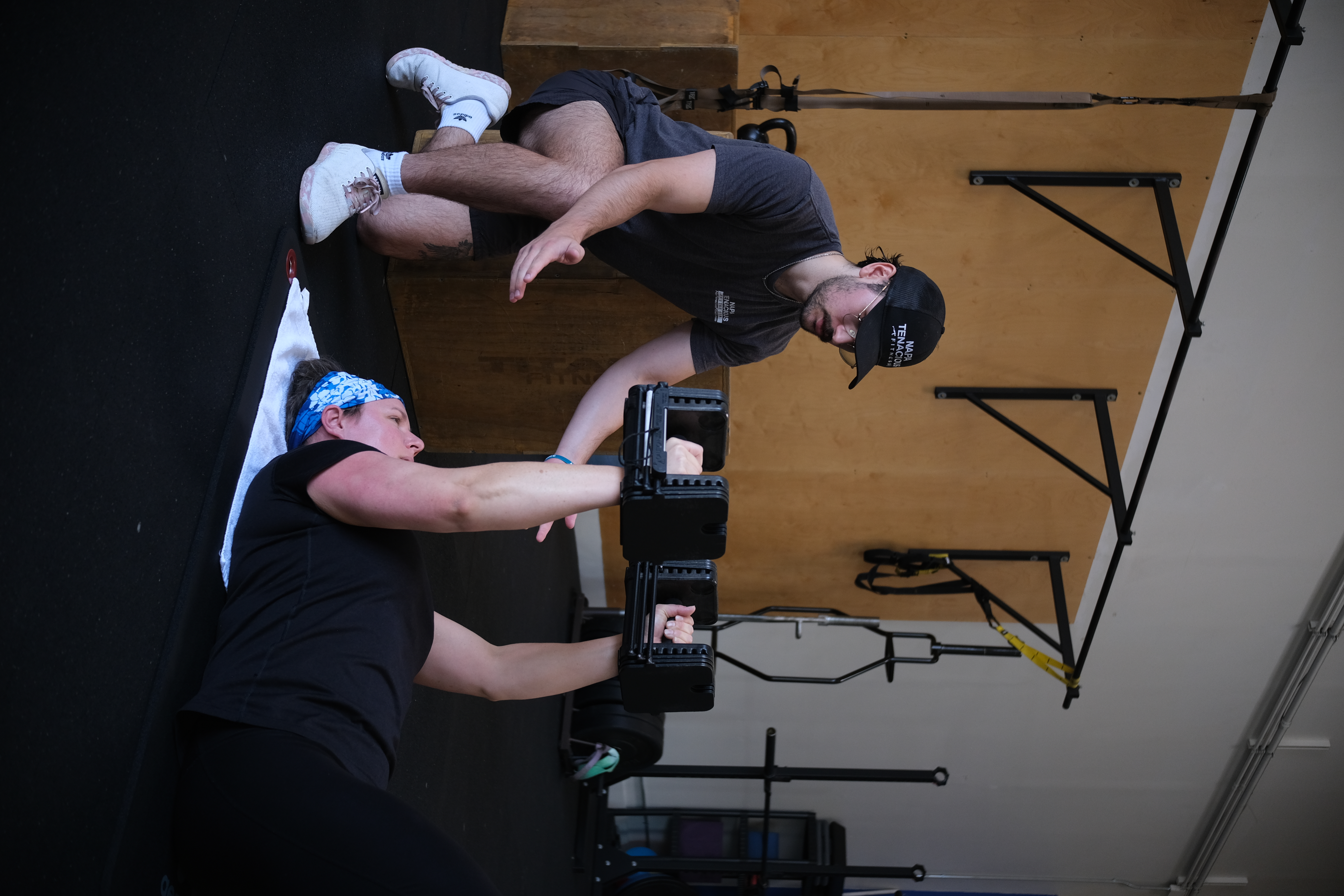
Sean McCawley, the founder and owner of Napa Tenacious Fitness in Napa, CA, welcomes questions and comments. Reach him at 707-287-2727, napatenacious@gmail.com, or visit the website napatenaciousfitness.com.