
Exercise journeys can be challenging, depending on a person’s circumstances and physical condition. The demands of time spent at our jobs, household chores, and family obligations can make it difficult to find time for exercise. Previous or current injuries and health conditions can create a daunting experience when starting or re-entering a fitness routine, as the risk of reinjury or accidentally performing an exercise incorrectly can be a concern. Advancement of age, progression of degenerative bone conditions such as osteoporosis and arthritis, and the fear of falling create barriers to entry when the thought of starting an exercise routine arises.
Driving to a local gym, a small-group fitness class, or a Pilates or Yoga class, finding a parking spot, and checking in at the front counter can be a little much for some people. Popular gyms such as Planet Fitness or InShape have a slew of cutting-edge exercise equipment that looks like the newest Alston Martin sports car to hit the market, which a rookie exercise participant might have no idea how to use. For a novice exerciser, entering a gym-like setting can be intimidating and deter them from interacting with this environment altogether. Furthermore, individuals recovering from injury, managing a pre-existing medical condition, or have suboptimal balance, the thought of investing in exercise with the idea to remedy the conditions they’re dealing with can feel like walking through a gasoline factory with a backpack full of strike anywhere matches.
Exercise isnt’ required to be performed in an “exercise only” environment, such as a gym or fitness class. Additionally, getting into an exercise routine doesn’t need to be considered a hyper athletic activity in which someone has to step into a piece of equipment, attend a class, or perform a set of back flips. A safe, effective exercise setting is attainable at most levels of health and fitness. Sometimes a safe and effective place to start is the ground.
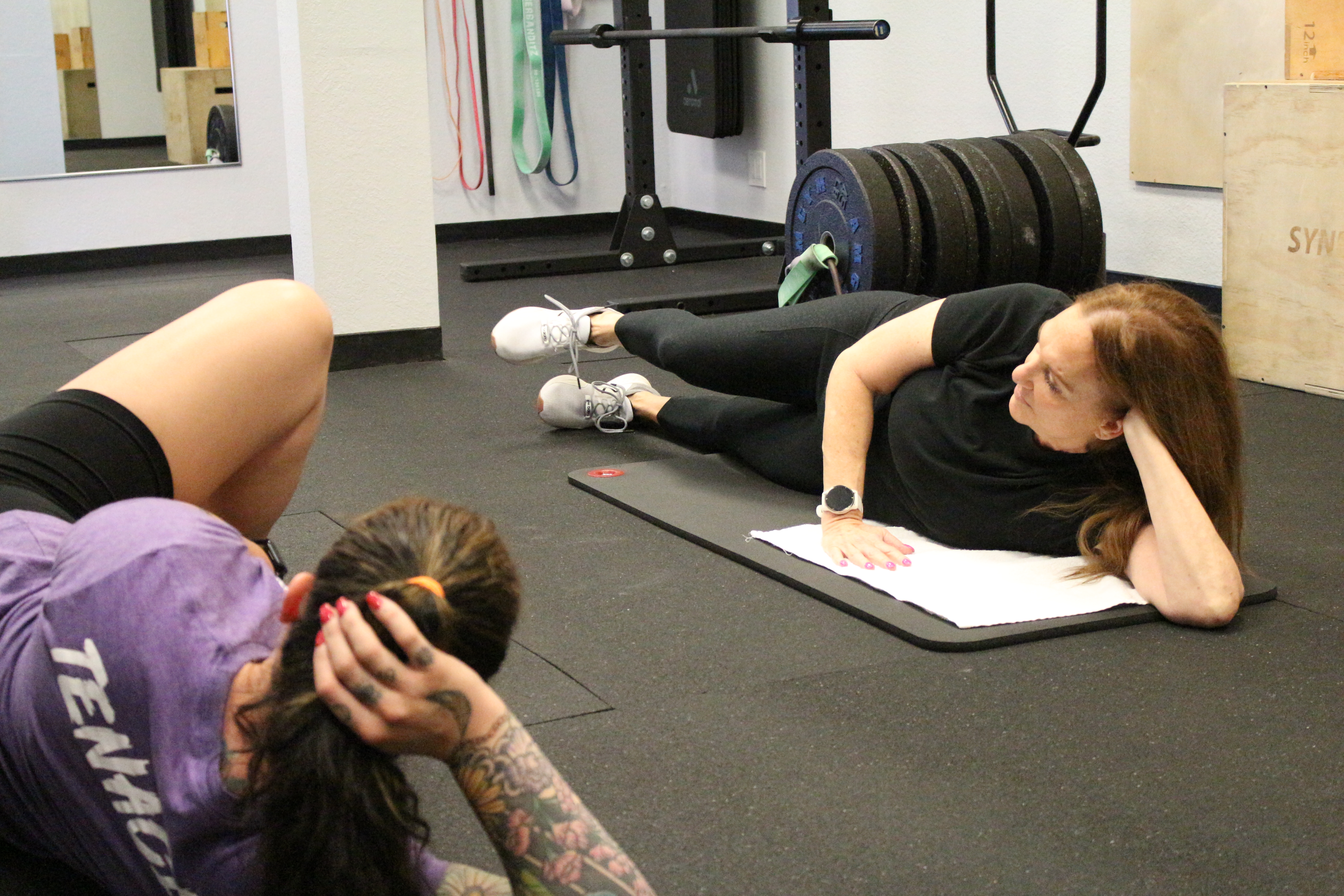
Performing exercises on the ground offers the benefits of safety, reduced compressive forces on the joints, and applicability to everyday activities. Not only are exercises performed on the ground beneficial in taking stress off of joints throughout exercise, but getting up and down from the ground is an important asset that plays a role in the tasks we perform throughout our day. Additionally, being comfortable with getting up and down from the ground assists in decreasing the likelihood of falling and preparing us in the unfortunate event if we do fall. If we practice getting up and down from the ground in our exercise routines, we reinforce our abilities to bend down to pick something up, get on our hands and knees to work on the ground, and most importantly, get up from a position in which we have to get down on our hands and knees.
The body endures more compressive forces in a standing position when compared to a supine position. When the body is standing, gravity exerts a downward force on the joints of the neck, shoulders, spine, hips, knees, ankles, and feet. While these forces endured throughout standing aren’t necessarily harmful, the addition of conducting exercises such as stepping, lunging, or squatting movements adds far more compressive forces. By lying on the ground and placing the body in a horizontal position, compressive forces on joints that are prone to overuse during exercise, such as the back, hips, and spine, are significantly reduced.
A supine position reduces joint compressive forces while still producing positive adaptations in muscles from exercise-induced stress. The microscopic damage applied to muscle cells from a skillfully designed exercise routine encourages strength gains and reinforces the development of muscle architecture as the body recovers following a bout of exercise. Conducting exercises on the ground reduces the risk of falling because the individual is already on the ground and has less chance of losing balance. However, ensuring a safe setting when getting up and down from the ground is critically important.
Attending gyms and taking instructor-led fitness classes can create powerful changes in people’s lives when utilized regularly. However, participating in activities that might be outside of someone’s comfort zone or the exercises present in gyms or fitness classes cause joint pain that introduces a fear of falling or injury, exploring alternate modes of exercise could be beneficial. Learning to perform ground-based exercises can be a valuable way to strengthen the body, reduce joint pain, and improve productivity and functional capacity throughout a fitness journey.
Sean McCawley, the founder and owner of Napa Tenacious Fitness in Napa, CA, welcomes questions and comments. Reach him at 707-287-2727, napatenacious@gmail.com, or visit the website napatenaciousfitness.com.