
Our knees are one of the most critically important components of our bodies, allowing us to perform a vast number of human functions throughout the experiences we participate in while we exist on Earth. Along with the ability to eat, breathe, see, and hear, humans are granted an ability that we depend on more than we often consider, the ability to walk. Ever since we took our first steps as toddlers, humans have been granted the unique ability to travel from one place to another using our lower extremities. If we couldn’t walk, we’d have a hard time performing simple tasks, such as using the bathroom, going to the kitchen to make a sandwich, or getting to our cars, which we depend on so much. Along with breathing, the topic of walking seems like something that isn’t necessarily given much thought. However, after an injury profound enough to impede the ability to walk normally hits someone, it’s easy to understand how the seemingly simple action of walking can be taken for granted.
Any injury that affects a person’s ability to operate efficiently throughout their days isn’t wished upon by anyone. One of the most debilitating injuries that affects a significant human function, such as walking, occurs in the knee joint. A few examples include sprained or torn cruciate ligaments, tears in the meniscus, or fractures to the thigh, shin, or kneecap following a fall. Once such injuries occur, walking can become quite a task, requiring a person to think in advance about their usual activities.
Following an injury to the knee, people may need to walk with a cast, a walking boot, crutches, a wheelchair, or a motorized wheelchair. These mechanisms aid people in their recovery by keeping weight off the affected joint, which requires passive healing following surgery or immobilization. This period, during which as much pressure as possible is taken off the joint in the first month or so following the injury, is crucial for the successful recovery of the tissue damaged by the injury. Initiating meetings with a physical therapist can’t be overstated in terms of the importance of recovering and getting back to everyday working capacity. However, even after recovery and clearance from physical therapy have been achieved, a sense of uncertainty and thoughts about how the joint was injured can impact confidence in participating in normal physical activity.
Traversing a set of stairs, getting in and out of the car, or simply bending down to pick up an object can produce shooting pain in the knee throughout the acute stages of recovery following a knee injury or corrective surgery procedure. The pressure on bruised bone, cartilage, and connective tissue affected by a traumatic strain or tear, or the healing of a reattached tendon or ligament, can send enough signals of pain to make some individuals tear up and vocalize obscenities to the nearby public audience. Any torquing rotational force, such as turning and planting the left foot to exit the driver’s side of a car, may feel unstable and weak. These examples of potential post-knee recovery circumstances illustrate common scenarios that can make a person apprehensive about their usual daily movements during knee recovery.
To assist in reestablishing a sense of confidence throughout movement after a knee injury, strength training has the power to significantly increase the structural integrity of the knee. Fortunately, the human body is equipped with the ability to adapt to exercise-induced stress by creating lean muscle mass. Along with understanding the mechanisms of injury that might re-injure the knee joint, educating oneself in exercises that strengthen the muscles crossing the knee joint is invaluable for regaining confidence in knee strength and ability.
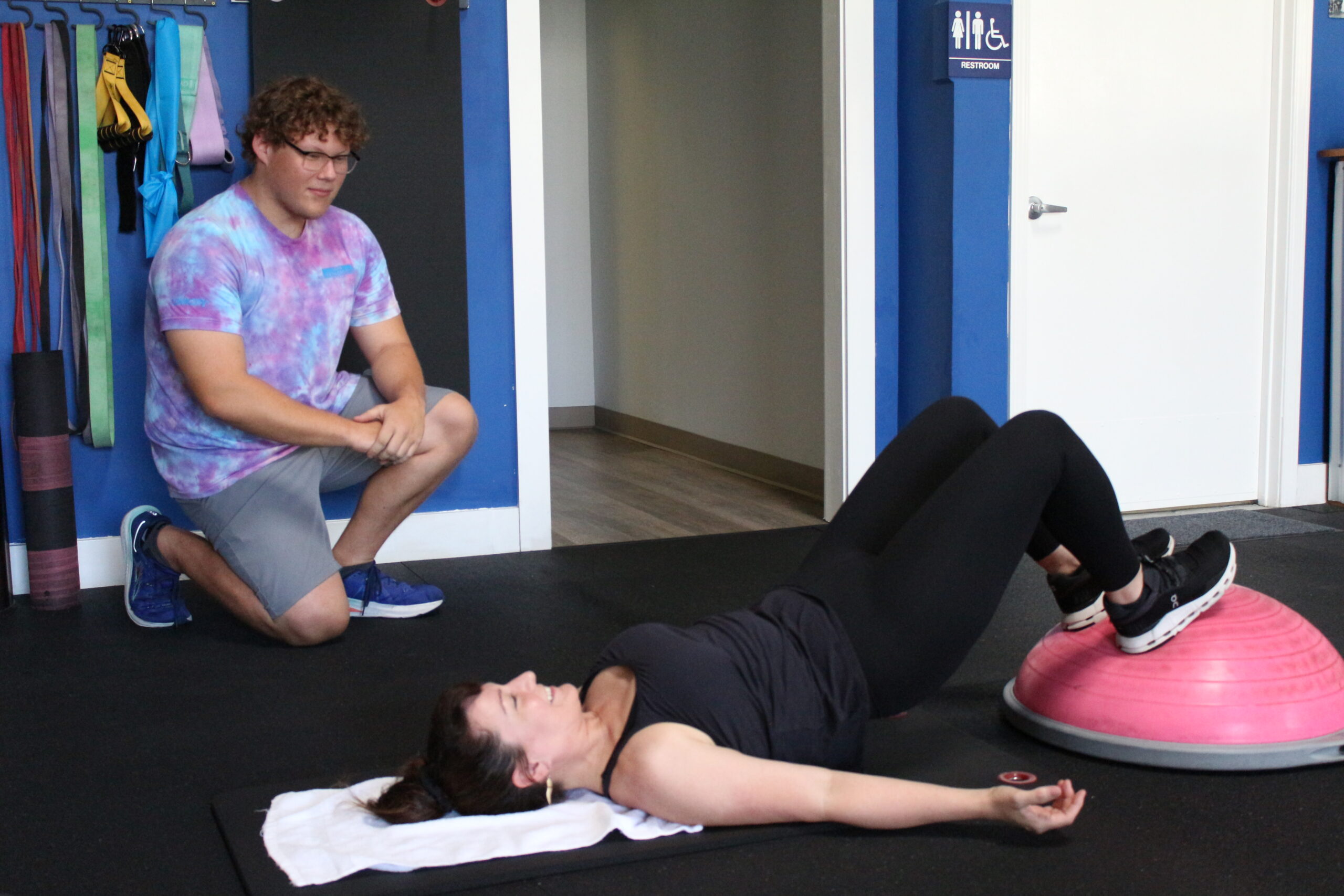
The hamstrings, quads, hip abductors, hip adductors, hip internal and external rotators, calves, and ankle muscles play a crucial role in stabilizing the knee. When starting a strengthening routine for the knees following a successful physical therapy and passive recovery plan, simple, safe, and effective exercises may include supine hamstring and glute-specific exercises. The supine position refers to the body position of lying flat on one’s back. Lying down supine and exercising the lower extremities produces less compressive forces on the knee than conducting standing exercises. Additionally, keeping the repetition amount lower is also useful during this period to decrease the number of repetitions on the injured joint. A low-impact, safe, and effective supine exercise we conduct with our personal training clients who might be afflicted with knee pain includes the isometric supine hip extension. This exercise is commonly known as a “bridging” technique. Here’s a brief explanation of how to perform it:
To perform the supine isometric hip extension, start by positioning yourself flat on your back on the ground with your arms extended and your knees bent. Press your feet into the ground and lift the hips upward until a brief muscular sensation is experienced in the hamstrings and glutes. Once your hips are extended upward, hold this position utilizing your glutes and hamstrings to stabilize the hips in an extended position for ten to thirty seconds.
Identifying movements that may exacerbate knee pain from a previous injury is crucial for mitigating knee pain. However, it’s essential to educate oneself on the muscles and connective tissue that provide the knee with its reinforcing capabilities to prevent future injury. After a presentation of injury has occurred, whether it be a minor scare or a life-changing event, taking time out to understand what muscles promote future injury prevention has the power to help us avoid future injuries and proceed to a healthy, happy, and strong quality of life.
Sean McCawley, the founder and owner of Napa Tenacious Fitness in Napa, CA, welcomes questions and comments. Reach him at 707-287-2727, napatenacious@gmail.com, or visit the website napatenaciousfitness.com.